
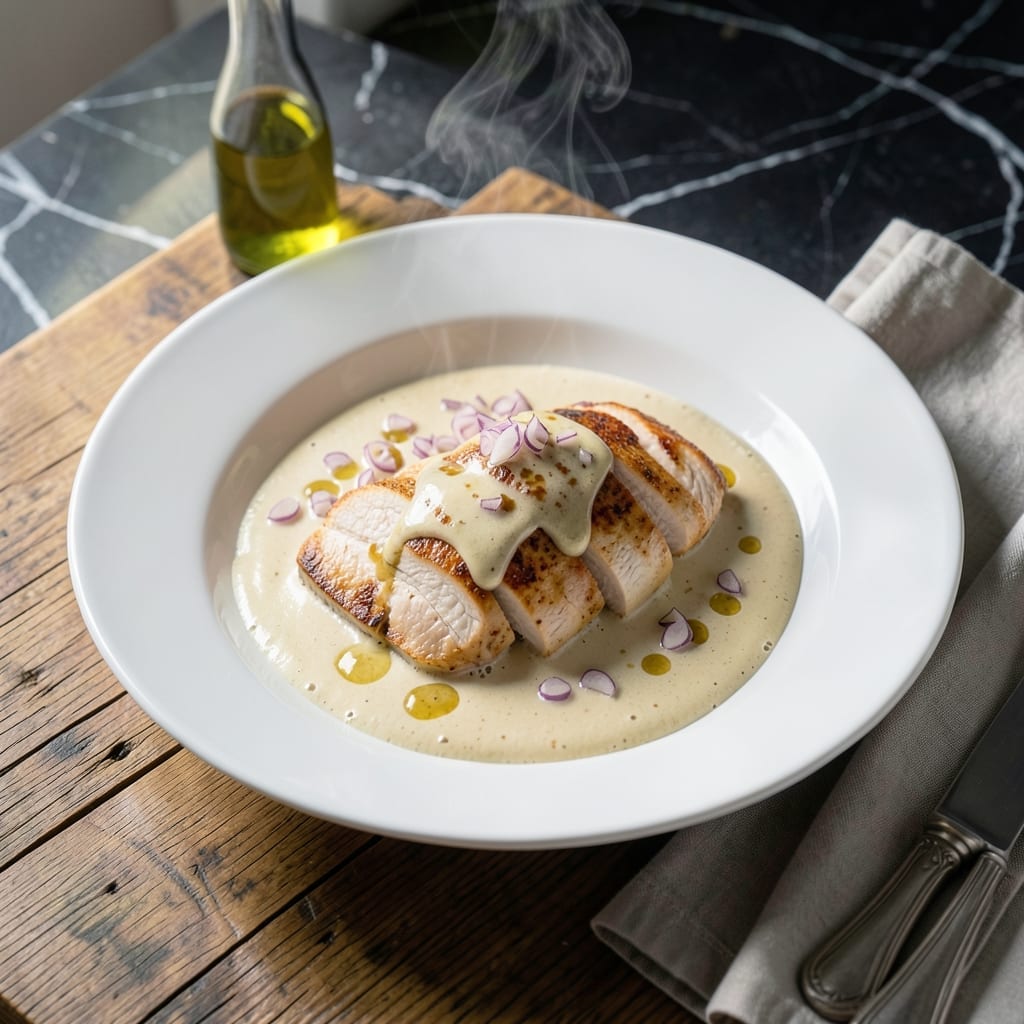
Mastering chicken veloute sauce transforms home cooking into restaurant-quality dishes with minimal effort. This French classic builds rich, silky depth from a simple foundation of butter, flour, and stock.
The technique is precise but straightforward: cook the roux just until golden, then whisk in warm stock gradually. The result is a smooth, velvety sauce that clings beautifully to poultry, vegetables, or pasta.
What makes this version special is its versatility. Use it as a base for creamy soups, as a topping for roasted chicken, or as the star of elegant casseroles. The flavor is rich yet balanced, never overpowering.
Store leftovers in the refrigerator for up to 3 days or freeze for longer storage. The sauce reheats beautifully, making it perfect for meal prep.
Ingredients for Chicken Veloute Sauce
Classic French foundation requires precise ingredients for velvety, restaurant-quality results.
| Ingredient | Amount | Notes |
|---|---|---|
| Unsalted Butter 🧈 | ½ cup | European-style preferred for richness |
| All-Purpose Flour 🌾 | ½ cup | Sifted for smooth roux |
| Chicken Stock 🍲 | 4 cups | Warm, preferably homemade |
| Heavy Cream 🥛 | ½ cup | Full-fat for velvety texture |
| Shallots 🧅 | 2 whole | Finely minced for depth |
| White Wine 🍷 | ½ cup | Dry variety like Sauvignon Blanc |
| Bay Leaf 🍃 | 1 whole | Fresh or dried, removed before serving |
| Fresh Thyme Sprigs 🌿 | 3 pieces | Stems removed before use |
| Kosher Salt 🧂 | 1 tsp | Diamond Crystal preferred |
| White Pepper 🌶️ | ½ tsp | Freshly ground for subtle heat |
The stock is non-negotiable here. Homemade chicken stock yields the cleanest flavor, but high-quality store-bought (like Better Than Bouillon or Swanson) works if you’re pressed for time. European-style butter—Plugrá or Kerrygold—has higher fat content for a richer roux. For the wine, any dry white works (Sauvignon Blanc or Pinot Grigio), but skip the cooking wine—it’s too salty and harsh.
No white wine? Substitute with additional stock plus a squeeze of lemon. Shallots can be replaced with yellow onion at a 1:1 ratio, though the flavor will be slightly more pungent. For a lighter sauce, half-and-half works in place of heavy cream, but the texture won’t be as luxurious. Fresh thyme is ideal, but dried thyme at one-third the amount is acceptable in a pinch.
Velouté thickens as it cools. Store in an airtight container in the fridge for up to 3 days or freeze for 3 months. Reheat gently over low heat, whisking frequently to restore its silky consistency. Avoid boiling, which can cause separation.
Why You’ll Love This Recipe
- One Pot Wonder: I love that I only need a saucepan and a whisk—no fancy equipment, just melt the butter, stir in flour, and slowly add the stock and cream.
- Rich & Silky: The shallots sweat in butter until sweet, then the cream makes it luxuriously smooth with a deep, savory chicken flavor.
- Endless Pairings: I drizzle it over roasted chicken, toss it with pasta, or even use it as a base for pot pies—honestly, it works with almost anything.
- Makes Extra: I always double the batch because it keeps beautifully in the fridge for up to five days, ready to transform leftovers into something special.
Step-by-Step Instructions for Chicken Veloute Sauce
Master this French technique and you’ll create a luxurious sauce with professional results every time.
Step 1: Create a Blond Roux Base
In a heavy-bottomed saucepan, melt the 0.5 cup Unsalted Butter over medium heat until foamy but not browned. I prefer European-style butter for its higher fat content, which creates a richer foundation.
Add the 0.5 cup All-Purpose Flour all at once and whisk constantly for 3-4 minutes until the mixture turns a pale, sandy blond color. This cooking process removes the raw flour taste while developing a subtle, nutty aroma. The roux should resemble wet sand and not take on any color beyond the lightest golden hue.
Step 2: Incorporate Aromatics and Deglaze
Add the 2 whole Shallots (finely minced) to the roux and cook for 1-2 minutes until just softened and translucent. The shallots should release their fragrance but not take on color, which would darken your finished sauce.
Pour in the 0.5 cup White Wine and deglaze the pan, scraping up any browned bits with a wooden spoon. Add the 1 whole Bay Leaf and 3 pieces Fresh Thyme Sprigs, then simmer for 2-3 minutes until the wine reduces by half. This step builds depth of flavor before adding the liquid.
Step 3: Gradually Add Warm Chicken Stock
Slowly pour in the 4 cups Chicken Stock, warm (preferably homemade), while whisking constantly. It’s crucial to add the stock in a thin stream to prevent lumps from forming. The mixture will thicken as it comes to a simmer.
Once all the stock is incorporated, reduce heat to medium-low and simmer for 15-20 minutes, stirring occasionally. The sauce should coat the back of a spoon with a velvety texture. Skim any foam that rises to the surface during this time for a cleaner finish.
Step 4: Finish with Heavy Cream and Seasoning
Remove the sauce from heat and discard the Bay Leaf and thyme stems. Stir in the 0.5 cup Heavy Cream until fully incorporated. The cream adds luxurious body and a subtle richness that defines a proper velouté.
Season with 1 tsp Kosher Salt and 0.5 tsp White Pepper, then taste and adjust as needed. I prefer Diamond Crystal kosher salt for its clean flavor and even distribution. The white pepper provides a gentle heat without the visual speckling of black pepper, maintaining the sauce’s elegant appearance.
Step 5: Strain and Serve
For the smoothest texture, strain the sauce through a fine-mesh sieve into a clean saucepan. This removes the shallots and any potential lumps, resulting in a silky finish. Press gently on the solids to extract all the flavor.
Reheat gently if needed, but do not boil. Serve immediately over poached chicken, roasted vegetables, or as a base for other classic dishes. The sauce should have a glossy sheen and coat food beautifully without being overly thick.
Pro Tips For Making Chicken Veloute Sauce
- Cook the Roux Longer: I learned this the hard way—let your butter and flour cook for at least 3-4 minutes until it turns a pale golden color. This removes the raw flour taste that ruins an otherwise smooth veloute.
- Warm the Stock First: After burning a batch, I finally figured out that adding cold stock to hot roux causes lumps. Heat your chicken stock gently in a separate pot before whisking it in.
- Strain the Shallots: Sounds weird, but it works: strain out the minced shallots after they’ve infused the sauce for 5-10 minutes. This gives you the flavor without the texture.
- Finish with Cold Cream: Skip adding warm cream to the hot sauce—it can curdle. Instead, temper it by whisking in cold heavy cream off the heat for a silky, stable finish.
Storing and Reheating This chicken veloute sauce
Refrigerator Storage
Let your sauce cool to room temperature, then transfer to an airtight container. I use glass jars with tight lids. Store in the fridge at 40°F or below for up to 3 days. The flavors will deepen as it rests. ❄️
Freezer Storage
For longer storage, freeze in 1-cup portions using silicone molds or freezer-safe containers. Leave ½ inch headspace for expansion. It keeps beautifully for up to 3 months without losing texture or flavor.
Stovetop Reheating
Gently reheat over low heat in a saucepan, whisking frequently. Add 1-2 tbsp warm chicken stock if it seems too thick. This method maintains the silky consistency best.
Microwave Reheating
Microwave in 30-second intervals at 50% power, stirring between each. Cover with a damp paper towel to prevent drying. I find this works well for single servings. 🔥
Texture Recovery
If your sauce separates or thickens too much, whisk in 1-2 tbsp warm cream off heat. For lumps, strain through a fine-mesh sieve again. The velvety texture will return with minimal effort.
Nutrition Facts
Frequently Asked Questions
Can I use milk instead of cream?
You can, but the texture won’t be as rich. Use whole milk for best results. The sauce may be slightly thinner but still tasty.
How do I fix a lumpy sauce?
Whisk vigorously first. If lumps persist, strain through a fine-mesh sieve. For prevention, add stock slowly while whisking constantly.
What can I use instead of white wine?
Substitute with equal parts stock plus 1 tbsp lemon juice. This adds the needed acidity without alcohol.
Why is my sauce too thin?
Simmer longer to reduce. If still thin, make a quick roux with 1 tbsp each butter and flour, whisk in, and cook for 2-3 minutes.

- Jollof Rice Sauce Recipe: West African Tomato and Spice Infusion - September 25, 2026
- Japanese Rice Soup Recipe: Umami-Rich Comfort in a Bowl - September 25, 2026
- Homemade Cream Of Rice Recipe: Silk-Smooth Breakfast in Minutes - September 25, 2026