
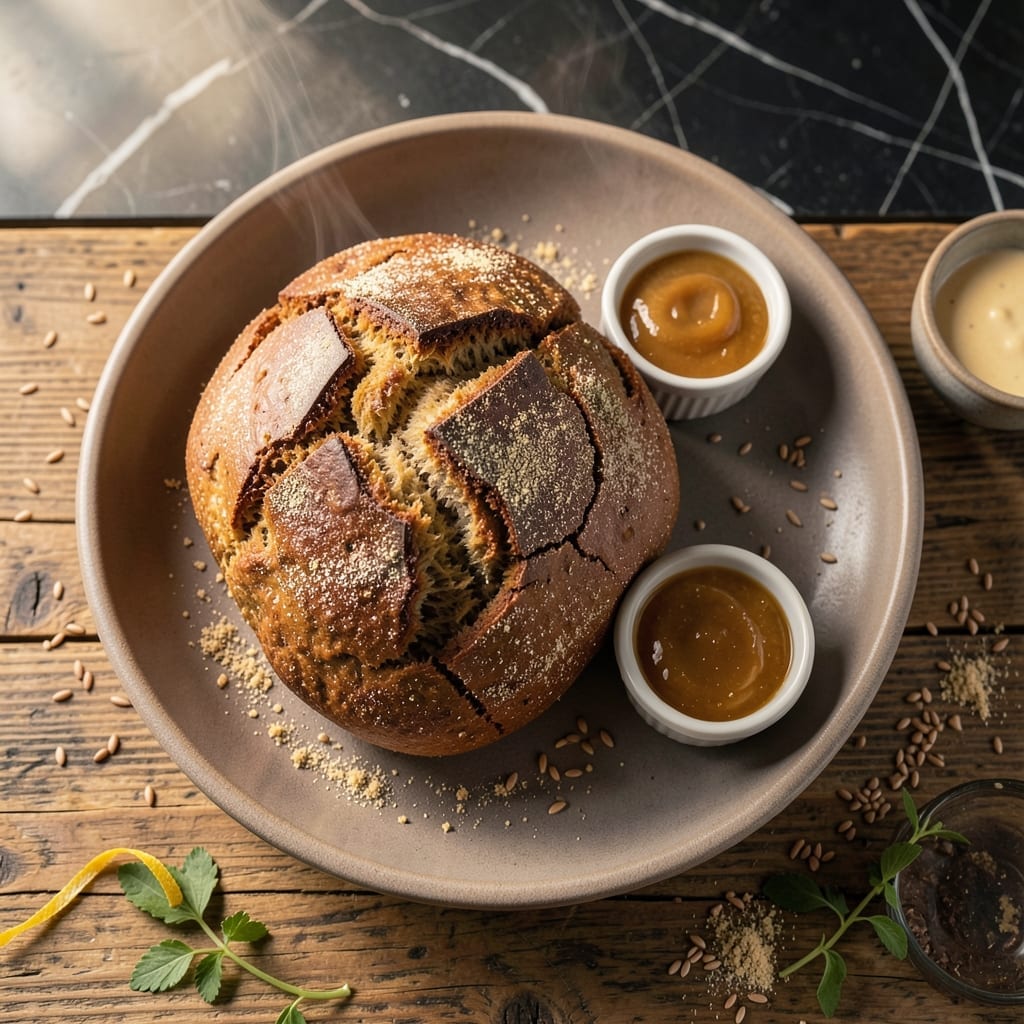
Achieving gluten-free sourdough with the perfect balance of nutty depth and chewy texture is possible with brown rice flour as your base.
This method guides you through fermentation, shaping, and baking to create a loaf that rivals traditional sourdough in both flavor and structure.
Ingredients for Gluten Free Brown Rice Sourdough Bread
Every ingredient here builds that signature chewy, nutty loaf you crave. Nothing complicated, just good baking.
| Ingredient | Amount | Notes |
|---|---|---|
| Brown Rice Flour 🌾 | 3 cups | Fine grind for best texture |
| Tapioca Starch 🌾 | 1 cup | Helps with elasticity |
| Sorghum Flour 🌾 | ½ cup | Adds nutty depth |
| Active Gluten-Free Sourdough Starter 🍞 | 1 cup | Fed and active |
| Warm Water 💧 | 1 ½ cups | About 110°F for activation |
| Psyllium Husk Powder 🌿 | 2 tbsp | Binds and adds structure |
| Sea Salt 🧂 | 1 ½ tsp | Fine grain for even distribution |
| Maple Syrup 🍁 | 2 tbsp | Balances acidity in starter |
| Apple Cider Vinegar 🍏 | 1 tbsp | Enhances fermentation |
| Olive Oil 🫒 | 2 tbsp | For greasing bowl |
| Xanthan Gum 🧪 | 1 tsp | Optional for extra chew |
| Sunflower Seeds 🌻 | ¼ cup | Optional for topping |
The brown rice flour is your foundation—Bob’s Red Mill or Anthony’s are solid choices (look for fine grind on the label). Psyllium husk powder is non-negotiable for structure; Whole Foods and Thrive Market carry it. Your sourdough starter needs to be gluten-free and bubbly before you begin (feed it 4-6 hours before mixing). The sorghum flour adds that toasty depth mentioned in the intro, so don’t swap it for another starch.
No psyllium husk? Ground flaxseed at double the amount works in a pinch (but texture won’t be as good). Out of sorghum? Buckwheat flour gives a similar earthy note. Maples syrup can be agave or date syrup—just avoid honey to keep it vegan. The xanthan gum is optional but helpful if your bread feels gummy. For the seeds, pumpkin or sesame swap in easily if that’s what you have.
The dough ferments best in a warm spot (75-80°F). Store your flours in airtight containers—they’ll keep for 3-6 months in a cool pantry. Baked loaves freeze beautifully for up to 3 months (slice before freezing for easy toasting). The starter? Feed it weekly and keep it on the counter if you bake often.
Why You’ll Love This Recipe
- One Bowl Wonder: I mix everything in a single bowl—no fancy equipment, just the starter, warm water, and those three flours.
- Nutty Depth: The brown rice and sorghum flours give it this warm, toasty flavor that’s way more interesting than plain white bread.
- Meal Prep Hero: I bake two loaves on Sunday and we’re set for sandwiches and toast all week. Honestly, it’s the only bread my family asks for now.
- Budget Friendly: Those three flours are pantry staples for me, and a little starter goes a long way. I’ll be real: it costs less than store-bought GF loaves.
Step-by-Step Instructions for Gluten Free Brown Rice Sourdough Bread
Here’s the method I’ve perfected after countless tests for this chewy, flavorful loaf.
Step 1: Mix the Dry Ingredients
In a large bowl, whisk together the 3 cups Brown Rice Flour, 1 cup Tapioca Starch, and 0.5 cup Sorghum Flour until no lumps remain. This blend of flours creates the perfect base for your bread.
Add the 2 tbsp Psyllium Husk Powder, 1.5 tsp Sea Salt, and 1 tsp Xanthan Gum. Whisk thoroughly for another 30 seconds to ensure even distribution. The psyllium husk is crucial here—it acts as the binder that replaces gluten’s elasticity.
Step 2: Combine Wet Ingredients and Create the Dough
In a separate bowl, combine the 1 cup Active Gluten-Free Sourdough Starter, 1.5 cups Warm Water, 2 tbsp Maple Syrup, and 1 tbsp Apple Cider Vinegar. Stir until the mixture is smooth and the starter is fully incorporated.
Pour the wet mixture into the dry ingredients. Using a silicone spatula, fold everything together until it forms a thick, sticky batter. The dough will be shaggy and sticky—that’s normal for gluten-free bread. Let it rest for 5 minutes to allow the flours to hydrate fully.
Step 3: First Rise and Shape the Loaf
After the initial rest, fold the dough once more to strengthen the structure. You’ll notice it becomes slightly more elastic. Lightly grease a 9×5-inch loaf pan with 2 tbsp Olive Oil, making sure to coat all sides evenly.
Transfer the dough to the prepared pan, using the spatula to smooth the top. Wet your hands slightly and press the dough gently to fill the corners. The dough should rise to about ¾ full in the pan.
Step 4: Final Proof and Bake
Cover the pan loosely with a damp towel and let it rise in a warm place for 1 to 1.5 hours, or until the dough has risen to the top of the pan. You’re looking for it to dome slightly above the rim.
Preheat your oven to 375°F. Once preheated, bake the bread for 50-55 minutes until the top is deep golden brown and a toothpick inserted in the center comes out clean. If the top browns too quickly, tent loosely with foil.
Step 5: Cool and Finish
Remove the bread from the oven and let it cool in the pan for 10 minutes. Then transfer it to a wire rack to cool completely. This cooling step is crucial—slicing too soon can result in a gummy texture.
Once completely cool, optionally sprinkle the top with 0.25 cup Sunflower Seeds for added crunch. Slice with a serrated knife for clean cuts. The bread keeps well at room temperature for 2-3 days in an airtight container.
Pro Tips For Making Gluten Free Brown Rice Sourdough Bread
- Proof Longer: I learned this the hard way—gluten-free sourdough needs a full 8-12 hours to rise properly, especially with brown rice flour. Rushing it gives you a dense, gummy loaf.
- Warm Your Starter: Pull your starter out of the fridge 4-6 hours before baking and feed it once. Cold starter slows fermentation, and you’ll end up with a flat, sour-tasting brick.
- Skip Dry Ingredients: Measure your flours by weight, not volume—brown rice flour compacts weirdly in cups. 150g of brown rice flour isn’t the same as 1 cup, and your texture will pay the price.
- Add Psyllium Husk: Sounds weird, but it works: 1 teaspoon of psyllium husk per cup of flour binds the dough better than xanthan gum. My loaves stopped crumbling after I started using it.
Best Sauces and Condiments for This gluten free brown rice sourdough bread
Sweet Spreads
This bread’s nutty depth pairs beautifully with almond butter or cashew butter—I spread 2 tbsp on warm slices for a protein boost. For a treat, try local honey drizzled over slices with a sprinkle of flaky sea salt. 💛
Savory Toppings
I love topping slices with mashed avocado and a pinch of red pepper flakes for a quick breakfast. Another favorite is hummus—Sabra roasted garlic is my go-to—spread thickly with cucumber slices.
Dipping Sauces
Olive oil and balsamic vinegar make a classic dip, especially with a dash of dried oregano. For something richer, warm marinara sauce with 1 tsp crushed garlic for dipping. 🌟
Breakfast Pairings
Toast slices and top with cream cheese and smoked salmon for a gluten-free bagel alternative. I also enjoy peanut butter with banana slices and a drizzle of maple syrup.
Cheese Options
For a simple snack, melt sharp cheddar or Gruyère on slices under the broiler for 2-3 minutes. The bread’s chewy texture holds up perfectly to the melted cheese.
Nutrition Facts
Frequently Asked Questions
Why use brown rice flour instead of white?
Brown rice flour adds nutty depth and extra fiber. It also creates a denser, chewier crumb that mimics traditional sourdough better than white rice flour.
Can I substitute psyllium husk powder?
Ground flaxseed works in a pinch, but use double the amount. Texture won’t be as good, as psyllium is best for binding in gluten-free baking.
How do I know when it’s fully baked?
The loaf should be deep golden brown with a hollow sound when tapped. A toothpick in the center should come out clean after 50-55 minutes at 375°F.
Why does my bread turn out gummy?
Likely sliced too soon! Cool completely on a wire rack for at least 1 hour to let the structure set. Also ensure your starter is active and bubbly.

- Fresh Turmeric Rice Recipe: Golden Grains with Earthy Warmth - October 7, 2026
- French Onion Brown Rice Recipe: Umami-Rich Grains With Caramelized Depth - October 7, 2026
- Rice Noodle Soup Recipe: Aromatic Broth with Silky Strands - October 7, 2026