
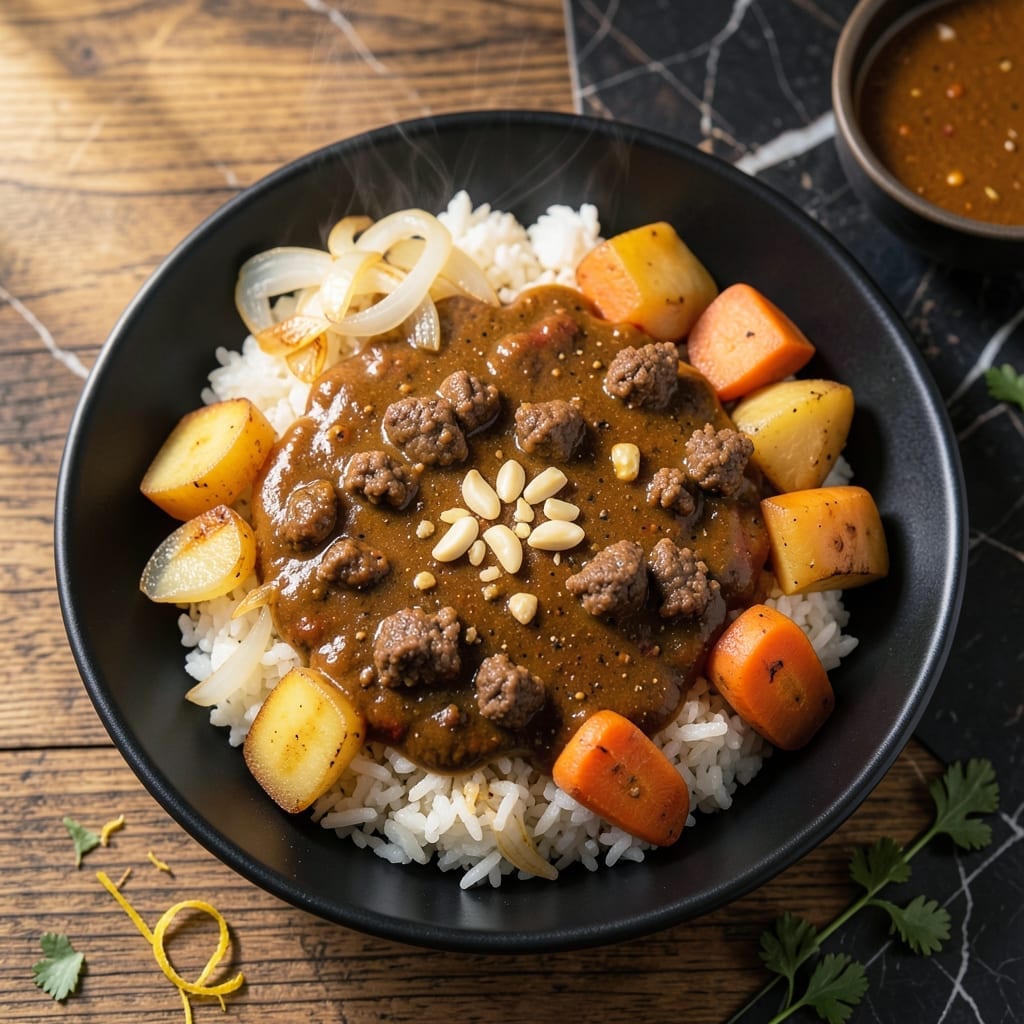
This Korean curry rice delivers warm comfort in every bite, with a rich golden sauce that clings perfectly to fluffy grains. The dish balances subtle sweetness with gentle spice, creating a satisfying meal that feels both nourishing and indulgent.
Simple ingredients come together to create a sauce that’s velvety and deeply flavorful. Serve it over steamed rice for a hearty, home-style dish that’s as easy to make as it is to love.
Ingredients for Korean Curry Rice
Velvety golden sauce meets tender beef and vegetables over fluffy jasmine rice for pure comfort.
| Ingredient | Amount | Notes |
|---|---|---|
| Japanese Curry Roux Blocks 🍛 | 4 pieces | Mild or medium spice level |
| White Onion 🧅 | 1 whole | Finely diced for even cooking |
| Garlic Cloves 🧄 | 4 cloves | Minced for maximum flavor |
| Carrots 🥕 | 2 whole | Peeled and sliced into rounds |
| Russet Potatoes 🥔 | 2 whole | Peeled and cubed into 1-inch pieces |
| Ground Beef 🥩 | 1 lb | 80/20 fat ratio preferred |
| Honey 🍯 | 2 tbsp | For balancing sweetness |
| Soy Sauce 🫒 | 2 tbsp | Low-sodium for control |
| Vegetable Oil 🛢️ | 2 tbsp | Neutral flavor for cooking |
| Water 💧 | 4 cups | For sauce consistency |
| Jasmine Rice 🍚 | 2 cups | Uncooked, rinsed before use |
| Apple 🍎 | 1 whole | Peeled and grated for natural sweetness |
| Bay Leaf 🍃 | 1 piece | For aromatic depth |
The curry roux is non-negotiable for authentic flavor—S&B Golden Curry or House Foods Vermont Curry are widely available at Asian markets or the international aisle. Look for the mild or medium spice level blocks; these dissolve perfectly into the sauce. The ground beef should have a decent fat ratio (80/20) for richness, and Costco or your local butcher will have the best quality.
No curry roux blocks? Curry powder at 3 tbsp per block gets you close, though the texture won’t be as velvety. Swap ground beef for ground turkey or tofu crumbles—just brown them well first. The apple can be omitted, but it adds a subtle sweetness that balances the spice. Gala or Fuji apples work best for their natural sweetness.
The cooked curry sauce keeps in the fridge for up to 5 days and actually tastes better the next day. Freeze portions for up to 3 months in airtight containers. Always cook the rice fresh—it absorbs the rich sauce best when hot.
Why You’ll Love This Recipe
- One Pot Wonder: I just dump the curry roux, veggies, and water in a pot—no fancy techniques, just simmer and serve.
- Rich & Complex: The carrots and potatoes soak up that deep, slightly sweet curry flavor until every bite tastes layered.
- Feeds a Crowd: I make a big batch on Sunday and it lasts us through Wednesday lunches, no problem.
- Budget Stretch: Between us, a few roux blocks and cheap veggies make a meal that feels way more expensive than it is.
Step-by-Step Instructions for Korean Curry Rice
This method ensures perfectly balanced flavors with a velvety sauce and tender components.
Step 1: Prepare the Base Vegetables and Protein
Finely dice the white onion, mince the 4 cloves garlic cloves, peel and slice the 2 whole carrots into rounds, and peel and cube the 2 whole russet potatoes into 1-inch pieces. This uniform sizing guarantees even cooking and consistent texture in every bite.
Peel and grate the apple—this adds natural sweetness that complements the curry. Heat the 2 tbsp vegetable oil in a deep pot over medium-high heat. Add the 1 lb ground beef and cook, breaking it apart with a wooden spoon, until browned and crumbly (about 5-6 minutes).
Step 2: Build the Aromatic Foundation
Add the diced white onion and cook for 3-4 minutes until translucent and softened. Stir in the minced garlic cloves and cook for 30 seconds until fragrant—this prevents bitterness while deepening flavor.
Incorporate the sliced carrots and cubed russet potatoes, stirring to coat in the rendered fat. Add the 2 tbsp soy sauce and 2 tbsp honey, tossing to distribute evenly. The soy sauce enhances umami, while the honey balances the savory notes with subtle sweetness.
Step 3: Develop the Curry Sauce
Pour in the 4 cups water and add the grated apple and 1 piece bay leaf. Bring to a boil, then reduce heat to medium-low and simmer for 10 minutes until the vegetables begin to soften. This step extracts the apple’s natural pectin, which slightly thickens the sauce.
Break the 4 pieces Japanese curry roux blocks into the pot, stirring constantly until fully dissolved and the sauce thickens to a velvety consistency (about 3-4 minutes). The roux should melt smoothly without clumping—maintain steady stirring to ensure a silky texture.
Step 4: Finish and Serve Over Rice
Simmer the curry for an additional 5-7 minutes until the russet potatoes and carrots are fork-tender and the sauce coats the back of a spoon. Discard the bay leaf before serving.
While the curry finishes, cook the 2 cups jasmine rice according to package instructions (typically 1 cup rice to 1½ cups water). Serve the curry hot over the steamed jasmine rice, ensuring each plate gets an equal distribution of vegetables, sauce, and meat. The sauce should pool slightly around the rice, inviting each bite to be savored.
Pro Tips For Making Korean Curry Rice
- Sear the Roux: Cook the curry roux blocks in oil for 1-2 minutes before adding liquids—I learned this the hard way after my first few batches tasted flat.
- Cut Potatoes Small: Dice the russet potatoes into 1-inch cubes so they cook through in the same time as the carrots, about 10-12 minutes.
- Skip Raw Garlic: Sauté the garlic cloves with the onions first to mellow the harshness; adding it raw can give the curry a bitter edge.
- Use Starchy Water: Add a splash of the potato boiling water to the curry for a thicker, glossier sauce—sounds weird, but it works.
Regional Styles of This Dish
Japanese Influence
Korean curry often uses Japanese curry roux blocks, like S&B Golden Curry, which give that iconic thick, velvety sauce. The Japanese introduced curry to Korea during their occupation, and it became a comfort food staple. I love how this version is milder than Indian curries but still deeply flavorful. 🌟
Korean Twists
What makes it distinctly Korean is the addition of grated apple and honey for natural sweetness, balancing the savory notes. Some Korean versions also include potatoes and carrots for heartiness, making it a one-pot meal that’s both filling and satisfying.
Seoul Street Food
In Seoul, you’ll find curry rice, or “ka-re raisu,” in casual eateries and as a popular takeout dish. It’s often served with a side of pickled radish or kimchi to cut through the richness. The dish is so beloved that it’s a common lunch option in schools and offices.
Home-Style Adaptations
At home, many Koreans customize their curry by adding ground beef or pork for extra protein. Some even stir in a spoonful of gochujang for a spicy kick. The beauty of this dish is its adaptability—it’s comforting yet endlessly customizable. 💛
Regional Variations
In Busan, coastal influences mean seafood curry rice is popular, often made with shrimp or squid. Meanwhile, in the countryside, you might find versions with tofu or mushrooms for a lighter, vegetarian-friendly take.
Nutrition Facts
Frequently Asked Questions
What can I use instead of curry roux blocks?
Use 3 tbsp curry powder per block, though the texture won’t be as smooth. Add a little cornstarch slurry to thicken if needed.
Can I make this vegetarian?
Swap ground beef for tofu crumbles or mushrooms. Use vegetable broth instead of water for extra depth.
How do I store leftovers?
Keep curry and rice separate in airtight containers. The sauce stays fresh for 5 days in the fridge or 3 months frozen.
Why add grated apple?
The apple adds natural sweetness and pectin, which helps thicken the sauce. It balances the savory notes perfectly.

- Mujadara Rice and Lentils Recipe: Earthy Spiced Lentils With Caramelized Onions - November 1, 2026
- Naija Fried Rice Recipe: Street-Style Spice With Veggie Crunch - November 1, 2026
- Mushy Rice Recipe: Fluffy Grains Transformed in Minutes - November 1, 2026