
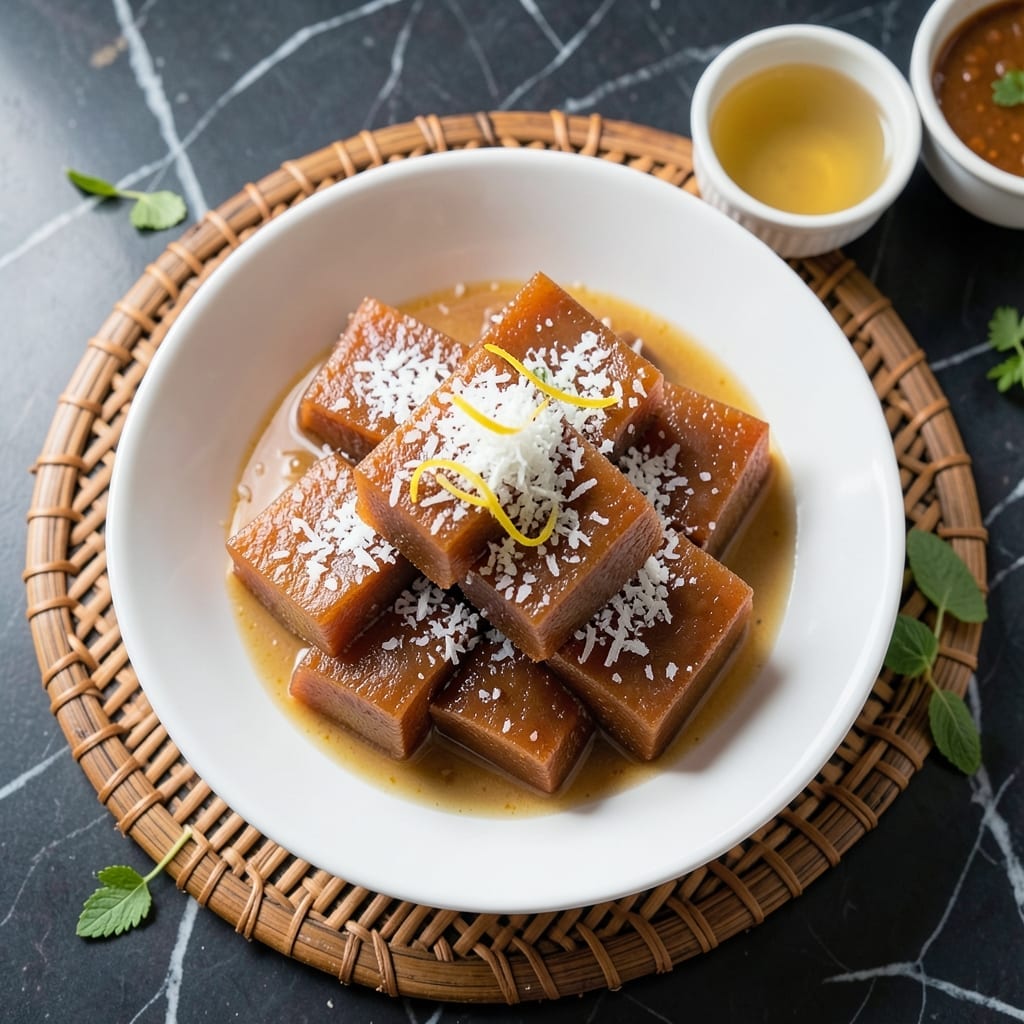
This traditional Filipino dessert combines cassava flour and rice flour for a uniquely chewy texture that’s hard to resist.
Brown sugar gives these treats their signature caramelized top and rich, sweet flavor. The steaming process ensures a moist, jelly-like consistency throughout.
I’ve refined this method to deliver consistent results every time, with just the right balance of densities from the two flours.
Serve warm for the best experience, when the texture is at its most tender and the aroma is most inviting.
Ingredients for Kutsinta Recipe with Cassava Flour and Rice Flour
These traditional Filipino ingredients create a chewy, caramelized dessert with perfect texture balance.
| Ingredient | Amount | Notes |
|---|---|---|
| Cassava Flour 🌾 | 1 ½ cups | Finely milled for smooth texture |
| Rice Flour 🌾 | 1 cup | White rice flour preferred |
| Brown Sugar 🧈 | 1 ½ cups | Light or dark variety |
| Water 💧 | 2 ½ cups | Warm for better dissolution |
| Lye Water 🧪 | 1 tsp | Food-grade essential for texture |
| Coconut Milk 🥥 | ½ cup | Full-fat for richness |
| Vanilla Extract 🌿 | 1 tsp | Pure extract for best flavor |
| Salt 🧂 | ¼ tsp | Balances sweetness |
| Neutral Oil 🫒 | 1 tbsp | For greasing molds |
| Sesame Seeds 🌰 | 1 tbsp | Optional garnish |
The flours are non-negotiable for authentic texture. Asian markets carry cassava flour (also called tapioca flour), while rice flour is widely available at Whole Foods or Amazon. Look for finely milled varieties—coarse textures yield grainy results. The lye water is critical for that signature jelly-like consistency. Check Asian grocery stores for food-grade lye water, or make your own with baking soda and water as a substitute.
No lye water? Substitute with 1 tsp baking soda dissolved in 1 tbsp water—texture will differ slightly. Brown sugar swaps work (muscovado for depth, coconut for caramel notes). For gluten-free assurance, verify your rice flour label. Coconut milk can be light coconut milk or even almond milk in a pinch, though richness will be reduced. The vanilla extract should be alcohol-free if avoiding alcohol.
Store dry ingredients in airtight containers for up to 6 months. Lye water keeps indefinitely unopened. Prepared kutsinta stays fresh for 3 days at room temperature, or 1 week refrigerated. Re-steam before serving to restore moisture and that coveted chewy texture.
Why You’ll Love This Recipe
- One Bowl Wonder: I just dump cassava flour, rice flour, and brown sugar in a bowl, mix with water and lye water, then pour—no fancy steps.
- Sticky Sweet Bliss: The brown sugar caramelizes into this chewy, glossy top layer that’s ridiculously good with the soft, slightly dense texture.
- Party or Snack: I make a big batch for fiestas, but honestly, it’s just as perfect as a 3 PM pick-me-up with coffee.
- Pocket-Friendly Treat: Cassava and rice flour are cheap, and this recipe stretches to feed a crowd without breaking the bank.
Step-by-Step Instructions for Kutsinta With Cassava Flour and Rice Flour
Master the technique for these glossy, chewy brown sugar cakes with this precise method.
Step 1: Combine Dry Ingredients for Smooth Texture
In a large mixing bowl, whisk together the 1.5 cups Cassava Flour and 1 cup Rice Flour until fully incorporated. The fine texture of cassava flour is essential for that signature smooth, slightly sticky consistency.
Next, add the 1.5 cups Brown Sugar and 0.25 tsp Salt, stirring until the mixture appears uniform in color. The salt enhances the caramel notes of the brown sugar without overpowering the sweetness.
Step 2: Create the Lye Water Mixture
In a separate bowl, carefully measure the 2.5 cups Water and ensure it is warm to the touch. Add the 1 tsp Lye Water to the warm water—this alkaline solution is what gives kutsinta its distinctive chewy texture and glossy sheen.
Stir gently but thoroughly to distribute the lye water evenly. Exercise caution, as lye water can be caustic. Once combined, set this mixture aside while you prepare the remaining wet ingredients.
Step 3: Incorporate Wet Ingredients and Rest the Batter
To the lye water mixture, add the 0.5 cup Coconut Milk and 1 tsp Vanilla Extract. The full-fat coconut milk enriches the batter, while the vanilla adds a subtle depth of flavor that complements the brown sugar.
Gradually pour the wet mixture into the dry ingredients, whisking continuously to prevent lumps from forming. The final batter should be smooth and slightly thick, with a consistency similar to pancake batter. Let it rest for 10-15 minutes to allow the flours to fully hydrate.
Step 4: Steam to Perfection
Lightly grease your steaming molds or ramekins with the 1 tbsp Neutral Oil to ensure easy removal. Pour the batter into each mold, filling them about ¾ full to allow room for expansion during steaming.
Place the molds in a steamer with boiling water. Cover and steam over medium-high heat for 30-35 minutes or until the tops are set and a toothpick inserted in the center comes out clean. The surface should have a slightly sticky, glossy finish.
Step 5: Garnish and Serve
Once steamed, allow the kutsinta to cool in the molds for 5 minutes. This helps them firm up slightly for easier removal. Gently run a thin knife around the edges to loosen, then invert onto a serving plate.
Sprinkle with the 1 tbsp Sesame Seeds for a nutty contrast and visual appeal. Serve warm for the best texture—they should be chewy with a slightly jelly-like consistency and a rich, caramelized flavor.
Pro Tips For Making Kutsinta Recipe With Cassava Flour And Rice Flour
- Steam Evenly: Use a cloth or parchment paper with holes to line your steamer so steam circulates freely—otherwise, theutsinta will cook unevenly, with a gummy center and tough edges.
- Balance the Flours: Stick to a 1:1 ratio of cassava to rice flour; I learned this the hard way—too much cassava makes it dense, while extra rice flour gives that chewy bounce kutsinta should have.
- Skip the Overmixing: Stir the batter just until the lye water is incorporated—overmixing develops gluten in the rice flour, turning your kutsinta rubbery instead of tender.
- Rest the Batter: Let the mixture sit for 10-15 minutes before steaming; it gives the flours time to hydrate fully and the lye water to work its magic for a smoother texture.
Make-Ahead Tips for This Recipe
Batter Prep Ahead
Mix your dry ingredients the night before and store in an airtight container. The flours blend better after resting, giving you a smoother batter. Just add wet ingredients when ready to steam.
Steam in Batches
prepare all molds at once, but steam in 2-3 batches if your steamer is small. Keep batter covered at room temperature between batches. I use my bamboo steamer for even heat distribution. ✨
Freeze for Later
Pour batter into greased molds, cover tightly with plastic wrap, and freeze for up to 1 month. Thaw overnight in the fridge before steaming. This works great for surprise guests.
Pre-Steam Molds
Grease and fill your molds, then cover and refrigerate for up to 12 hours. This lets the lye water work its magic slowly. Steam directly from the fridge—just add 5 minutes to cooking time.
Storage Tips
Steamed kutsinta keeps well at room temperature for 2 days in an airtight container. For longer storage, refrigerate for up to 5 days. Re-steam for 3-4 minutes to restore that fresh texture.
Reheating Trick
For the best results, sprinkle a few drops of water over each piece before re-steaming. This prevents drying out. I always do this when serving leftovers to guests. 💡
Nutrition Facts
Frequently Asked Questions
Can I replace lye water with baking soda?
Yes, but texture will differ slightly. Use 1 tsp baking soda dissolved in 1 tbsp water as a substitute. The chewiness won’t be as pronounced, but it’s a safe alternative.
Why does my batter have lumps?
Lumps form if dry ingredients aren’t whisked thoroughly before adding liquids. Sift the flours first and mix gradually while whisking continuously.
How do I know when it’s done steaming?
Check at 30 minutes—the top should look set with a glossy sheen. Insert a toothpick; it should come out clean with no wet batter.
Can I use only cassava flour?
Not recommended. Rice flour adds structure and prevents the texture from becoming too gummy. Stick to the 1.5:1 ratio for best results.

- Mujadara Rice and Lentils Recipe: Earthy Spiced Lentils With Caramelized Onions - November 1, 2026
- Naija Fried Rice Recipe: Street-Style Spice With Veggie Crunch - November 1, 2026
- Mushy Rice Recipe: Fluffy Grains Transformed in Minutes - November 1, 2026