
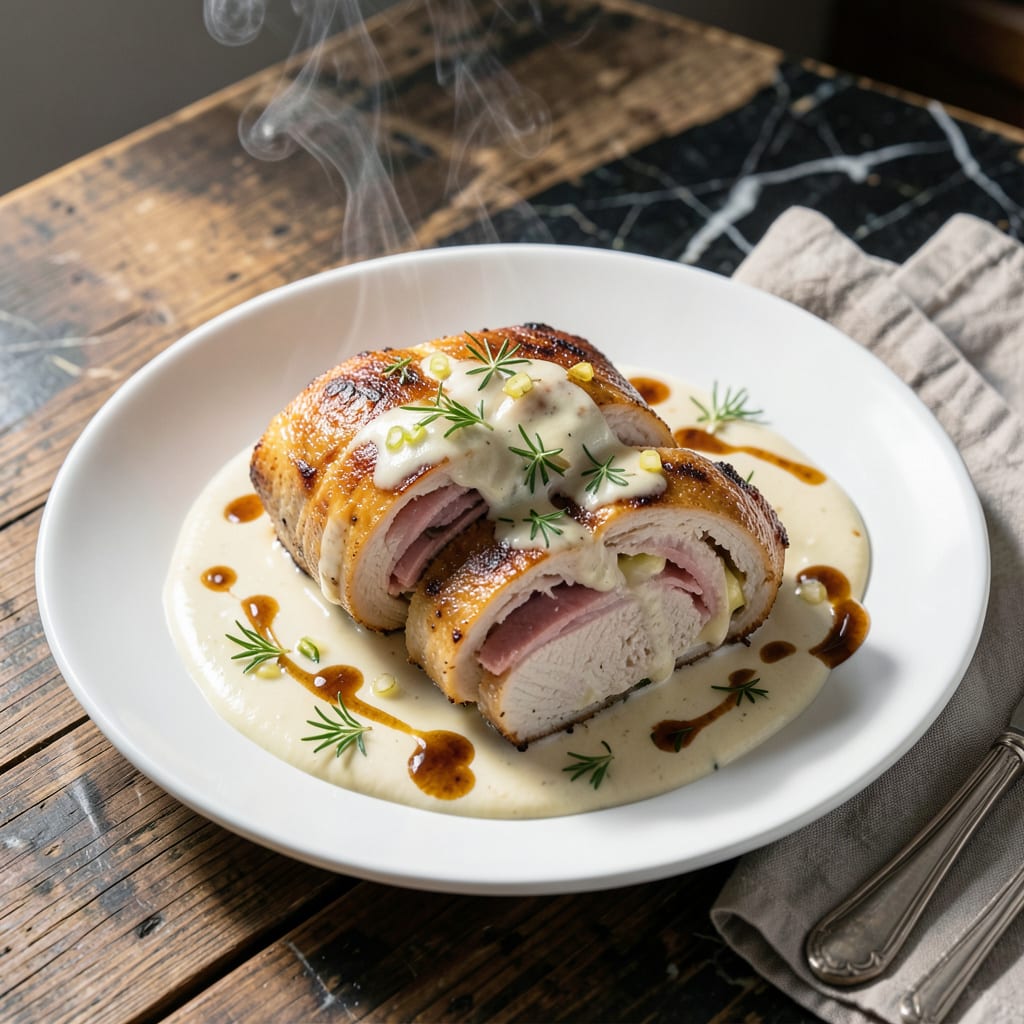
This sauce transforms chicken cordon bleu into a restaurant-quality dish with its creamy texture and rich depth of flavor. The combination of tangy Dijon and nutty Gruyère creates a luxurious finish that complements the ham and chicken perfectly.
Ready in 15 minutes, this sauce is simple to prepare but delivers complex results. It pairs beautifully with the dish and can be made ahead for stress-free entertaining.
Ingredients for Chicken Cordon Blue Sauce
These nine ingredients create a luxurious sauce with tangy depth and nutty richness.
| Ingredient | Amount | Notes |
|---|---|---|
| Unsalted Butter 🧈 | 3 tbsp | For velvety texture base |
| All-Purpose Flour 🌾 | 2 tbsp | Creates smooth roux foundation |
| Whole Milk 🥛 | 1 cup | Full-fat for creaminess |
| Heavy Cream 🥛 | ½ cup | Rich thickness essential |
| Dijon Mustard 🟡 | 2 tbsp | High-quality for tangy depth |
| Gruyère Cheese 🧀 | ¾ cup | Freshly grated nutty flavor |
| Chicken Stock 🍲 | ½ cup | Low-sodium preferred |
| White Wine 🍷 | ¼ cup | Dry variety recommended |
| Shallot 🧅 | 1 whole | Finely minced for subtle sweetness |
| Salt 🧂 | ½ tsp | Kosher or sea salt |
[recipeingredientscaler]
The Gruyère is non-negotiable here—Murray’s Cheese or Whole Foods carry excellent aged wheels with that crystalline texture that melts beautifully. For the Dijon, Maille or Grey Poupon offer the complexity this sauce demands. Unsalted butter allows precise seasoning control (the good stuff, not margarine). Always grate the cheese fresh—pre-shredded contains anti-caking agents that affect texture.
No Gruyère? Comté or Emmental work at a 1:1 ratio, though slightly sweeter. Swap white wine for extra chicken stock plus 1 tsp lemon juice. For a lighter version, half-and-half replaces the heavy cream (texture won’t be as velvety). Shallots can be yellow onion in a pinch, but reduce quantity by half. The flour is for thickening—cornstarch at half the amount works too.
Sauce keeps 3-4 days refrigerated in an airtight container. Reheat gently over low—don’t boil or it’ll separate. Freezes for 2 months (stir vigorously after thawing). Best made fresh, but the flavors deepen after a day.
Why You’ll Love This Recipe
- Five Ingredients: I love that this comes together with just butter, flour, milk, cream, and Dijon—no last-minute grocery runs.
- Creamy Kick: The Dijon cuts through the richness of the cream, giving it that tangy depth I crave.
- Dinner Upgrade: This sauce turns simple baked chicken or even leftovers into something restaurant-worthy.
- Budget Stretch: A little goes a long way, and it’s way cheaper than store-bought sauces with half the flavor.
Step-by-Step Instructions for Chicken Cordon Bleu Sauce
Master this velvety sauce with precise technique for a restaurant-quality finish.
Step 1: Create a Roux Base
Melt the 3 tbsp Unsalted Butter in a heavy saucepan over medium heat. Watch for the foaming to subside, signaling the butter is ready for the 2 tbsp All-Purpose Flour.
Whisk in the flour vigorously to form a smooth paste. Cook for 1-2 minutes until the mixture turns a light golden color and emits a nutty aroma. This roux will thicken the sauce without lumping.
Be patient here—undercooked flour tastes raw, while overcooked flour darkens the sauce. The roux should bubble gently but not brown.
Step 2: Build Flavor with Aromatics and Deglazing
Add the finely minced 1 whole Shallot to the roux and cook for 1 minute until just softened. The shallot’s mild sweetness complements the dish without overpowering it.
Pour in the 0.25 cup White Wine while whisking constantly. The liquid will thicken immediately as it hits the hot roux, then loosen into a smooth mixture. Simmer for 2 minutes to cook off the alcohol.
Add the 0.5 cup Chicken Stock and whisk until fully incorporated. The sauce base should now coat the back of a spoon.
Step 3: Incorporate Creamy and Tangy Elements
Gradually whisk in the 1 cup Whole Milk and 0.5 cup Heavy Cream. The mixture will thicken significantly as it heats—maintain medium-low heat to prevent scorching.
Stir in the 2 tbsp Dijon Mustard and 0.5 tsp Salt. The mustard’s sharpness cuts through the richness while the salt enhances all flavors. Cook for 3-4 minutes until the sauce visibly thickens.
Step 4: Finish with Gruyère for Luxurious Depth
Reduce heat to low and add the 0.75 cup Gruyère Cheese a handful at a time, stirring until each addition melts completely. The cheese transforms the sauce into a velvety, glossy finish with nutty undertones.
Continue stirring for 2-3 minutes until the sauce reaches your desired consistency. It should coat the back of a spoon and leave a clear path when you draw your finger through it. Taste and adjust seasoning if needed.
Serve immediately over chicken cordon bleu or other dishes, as the sauce thickens further as it cools.
Pro Tips For Making Chicken Cordon Blue Sauce
- Whisk Constantly: I learned this the hard way—once you add the milk to your butter-flour roux, keep whisking nonstop until it thickens, or you’ll end up with lumpy sauce.
- Warm the Milk: Sounds weird, but it works: heat your whole milk for 30 seconds in the microwave before adding it to the roux to prevent a pasty, uneven texture.
- Skip Low-Fat Swaps: After trying it once with 2% milk, I can confirm: whole milk and heavy cream are non-negotiable here for that rich, velvety finish.
- Bloom the Mustard: Add the Dijon mustard to the hot butter for 30 seconds before the flour—it mellows the sharpness and deepens the flavor in the final sauce.
Essential Equipment for chicken cordon blue sauce
Heavy Saucepan
A 2-3 quart heavy-bottomed saucepan is essential for even heat distribution. I recommend All-Clad Stainless Steel or Le Creuset Enameled Cast Iron for their superior heat retention. Thin pans risk scorching the delicate roux and cream base. 🔥
Whisk Selection
Use a sturdy balloon whisk (I prefer OXO Good Grips) for smooth roux creation and lump-free sauce. The rounded shape helps reach corners of your pan. Avoid wooden spoons—they don’t break up flour clumps effectively.
Cheese Grater
Freshly grated Gruyère melts far better than pre-shredded. A Microplane or box grater with fine holes creates the perfect texture. I keep mine dedicated to hard cheeses to avoid flavor transfer.
Temperature Control
An instant-read thermometer helps monitor sauce temperature—keep it below 180°F to prevent separation. I use a ThermoWorks Thermapen for precise readings. Low and slow is key with dairy-based sauces.
Fine Mesh Strainer
For ultra-smooth results, strain the finished sauce through a fine mesh sieve. This catches any bits of shallot or flour that didn’t fully incorporate. I also use it to dust dishes with powdered sugar or spices.
Serving Tools
A ladle or small gravy boat makes elegant presentation easy. The sauce’s thick consistency works best with a 1/4 cup ladle. I also keep silicone spatulas on hand for scraping every last bit from the pan.
Nutrition Facts
Frequently Asked Questions
Can I use a different cheese?
Yes! Try Comté or Emmental at a 1:1 ratio for similar nutty flavor. Avoid sharp cheddar—it overpowers the Dijon.
How do I fix a lumpy sauce?
Strain through a fine mesh sieve or blend with an immersion blender. Prevent lumps by whisking constantly when adding flour.
Can I make this ahead?
Store in an airtight container for 3-4 days. Reheat gently on low heat to prevent separation.
What if I don’t have white wine?
Substitute extra chicken stock plus 1 tsp lemon juice. The acidity mimics wine’s brightness.

- Jollof Rice Sauce Recipe: West African Tomato and Spice Infusion - September 25, 2026
- Japanese Rice Soup Recipe: Umami-Rich Comfort in a Bowl - September 25, 2026
- Homemade Cream Of Rice Recipe: Silk-Smooth Breakfast in Minutes - September 25, 2026