
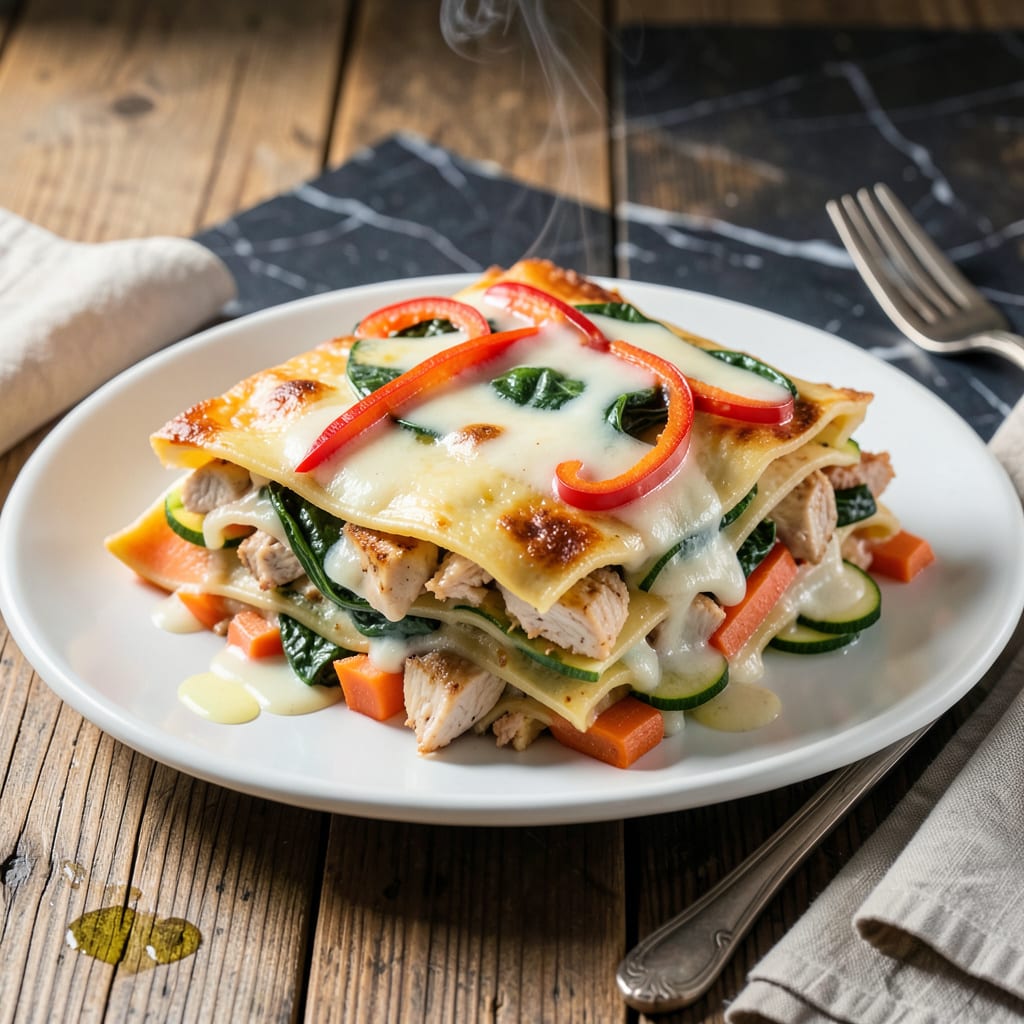
This layered lasagna combines tender chicken and garden-fresh vegetables with a velvety béchamel that elevates every bite. The key is building flavors in stages, from sautéed aromatics to a creamy white sauce that binds everything together.
Each layer delivers texture and richness without heaviness. The result is a satisfying main course that balances hearty protein with the brightness of seasonal vegetables, all enveloped in that smooth sauce.
Ingredients for Chicken Vegetable Lasagna Recipe White Sauce
Fresh vegetables, tender chicken, and a creamy béchamel come together for this layered delight.
| Ingredient | Amount | Notes |
|---|---|---|
| Lasagna Noodles 🍝 | 12 sheets | Oven-ready or pre-cooked |
| Chicken Breast 🍗 | 1 ½ lb | Boneless, skinless, diced |
| Zucchini 🥒 | 2 whole | Thinly sliced lengthwise |
| Bell Peppers 🌶️ | 2 whole | Mixed colors, diced |
| Carrots 🥕 | 2 whole | Julienned or thinly sliced |
| Spinach 🥬 | 5 oz | Fresh, chopped |
| Onion 🧅 | 1 whole | Finely diced |
| Garlic Cloves 🧄 | 4 cloves | Minced |
| Butter 🧈 | ½ cup | Unsalted, for béchamel |
| All-Purpose Flour 🌾 | ½ cup | For roux base |
| Whole Milk 🥛 | 4 cups | Full-fat for creaminess |
| Parmesan Cheese 🧀 | 1 cup | Freshly grated from block |
| Mozzarella Cheese 🧀 | 8 oz | Shredded, full-fat |
| Nutmeg 🌰 | ¼ tsp | Freshly grated preferred |
| Salt 🧂 | 1 ½ tsp | Divided, kosher preferred |
| Black Pepper 🌶️ | ½ tsp | Freshly ground |
[recipeingredientscaler]
The béchamel demands full attention. Whole milk is non-negotiable for that velvety texture—low-fat versions simply won’t deliver. Use European-style butter (like Plugrá) for superior richness. For the Parmesan, Parmigiano-Reggiano is the gold standard; avoid pre-grated, which contains anti-caking agents that mute flavor. Fresh nutmeg, grated directly into the sauce, adds depth that pre-ground can’t match.
Swaps are possible but require care. Turkey breast can replace chicken without texture loss. For a lighter version, substitute half-and-half for 2 cups milk, but expect less lushness. No fresh spinach? Frozen thawed and drained works—just squeeze out excess moisture. Zucchini can be swapped for eggplant (salt and drain first to remove bitterness).
Assemble and bake immediately, or refrigerate the lasagna (unbaked) for up to 24 hours. Leftovers keep 4-5 days refrigerated or 3 months frozen. Reheat covered with foil to prevent cheese from over-browning—remove foil for the last 10 minutes to crisp the top.
Why You’ll Love This Recipe
- One Pot Magic: I love that everything cooks in one dish—no pre-boiling noodles, just layer and bake.
- Creamy Comfort: The white sauce soaks into the lasagna noodles and chicken, making each bite rich and satisfying.
- Feeds the Crew: This makes enough for a family dinner plus leftovers for lunch the next day.
Step-by-Step Instructions for Chicken Vegetable Lasagna with White Sauce
This method ensures perfectly layered textures with a velvety béchamel that binds everything together.
Step 1: Prepare the Chicken and Vegetables
Dice the 1.5 lb chicken breast into ½-inch pieces and season with ½ tsp salt and ½ tsp black pepper. Sauté in a skillet over medium-high heat until lightly browned and cooked through, about 6-8 minutes. The chicken should reach 165°F internally.
In the same skillet, sauté the finely diced onion and minced garlic cloves until fragrant, about 2 minutes. Add the diced bell peppers, julienned carrots, and thinly sliced zucchini, cooking for 5 minutes until tender-crisp. Stir in the 5 oz chopped spinach until just wilted, then remove from heat.
Step 2: Craft the Velvety Béchamel Sauce
In a saucepan, melt the ½ cup butter over medium heat. Whisk in the ½ cup all-purpose flour to form a smooth roux, cooking for 1-2 minutes until golden and bubbly. This step removes the raw flour taste and builds flavor.
Gradually whisk in the 4 cups whole milk, a little at a time, ensuring no lumps form. Bring to a gentle simmer, stirring constantly, until the sauce thickens enough to coat the back of a spoon, about 5-7 minutes. Stir in the 1 cup Parmesan cheese, ¼ tsp nutmeg, and remaining 1 tsp salt until smooth.
Step 3: Layer and Bake the Lasagna
Spread a thin layer of béchamel on the bottom of a 9×13-inch baking dish. Arrange 4 sheets lasagna noodles in a single layer, followed by half the chicken-vegetable mixture. Drizzle with ⅓ of the remaining béchamel and sprinkle with ⅓ of the 8 oz mozzarella cheese.
Repeat the layers: noodles, remaining chicken-vegetable mixture, ⅓ of the béchamel, and ⅓ of the mozzarella cheese. Top with the final 4 sheets lasagna noodles, the last of the béchamel, and the remaining mozzarella cheese. Bake at 375°F for 25-30 minutes until bubbly and golden.
Step 4: Rest and Serve
Remove the lasagna from the oven and let it rest for 10 minutes before slicing. This allows the layers to set, making it easier to serve neat portions. The top should be golden brown with the cheese fully melted and slightly blistered in spots.
Slice into squares and serve immediately. Each portion will showcase the creamy béchamel, tender vegetables, and juicy chicken in every bite. The sauce should be thick enough to cling to the noodles without running off the plate.
Pro Tips For Making Chicken Vegetable Lasagna Recipe White Sauce
- Salt the Zucchini: Sprinkle sliced zucchini with salt and let it sit for 10 minutes before cooking to draw out excess moisture. I learned this the hard way—my first few lasagnas were watery disasters.
- Shred the Chicken: Use two forks to shred the cooked chicken breast into thin strips instead of chopping—it distributes more evenly and soaks up the white sauce better.
- Parboil the Noodles: Boil lasagna noodles for just 2-3 minutes less than package instructions so they finish cooking in the oven without turning mushy. After overcooking them once, I now set a loud timer.
- Sauté the Veggies: Cook the bell peppers and carrots for 5-6 minutes until slightly softened before layering—raw veggies stay crunchy and make the lasagna harder to slice. Sounds obvious, but I skipped this step once and regretted it.
Essential Equipment for This Recipe
Baking Dish Essentials
For this lasagna, I always use a 9×13-inch glass baking dish—it distributes heat evenly and lets you see the layers. Pyrex is my go-to brand. A 3-quart capacity gives enough room for all the layers without overflowing. 💛
Saucepan for Béchamel
A heavy-bottomed 3-quart saucepan prevents scorching when making the roux. I recommend All-Clad stainless steel for its even heat distribution. The straight sides help with whisking as the sauce thickens.
Skillet for Chicken
Use a 12-inch nonstick skillet for browning the chicken and sautéing vegetables. Calphalon or T-fal work well. The large surface area lets you cook everything in batches without overcrowding.
Quality Whisk
A flat-bottomed silicone whisk is perfect for the béchamel—it scrapes the pan bottom while preventing scratches. I use mine from OXO. The flexible head reaches corners easily for smooth sauce.
Cheese Grater
Freshly grated Parmesan makes a huge difference. I use a microplane grater for ultra-fine texture that melts beautifully. For mozzarella, a standard box grater with ¼-inch holes gives perfect shreds.
Lasagna Layers Helper
A long offset spatula helps spread sauce evenly without disturbing layers. I also keep a laser thermometer handy to check the chicken reaches 165°F before assembling. 🌡️
Nutrition Facts
Frequently Asked Questions
Can I use no-boil noodles for this?
Yes, no-boil noodles work perfectly, just add ¼ cup extra milk to the béchamel to ensure they soften properly.
How do I prevent a watery lasagna?
Drain sautéed vegetables well and use full-fat milk in the béchamel. Let the lasagna rest for 10 minutes after baking to set.
Can I make this ahead of time?
Assemble the lasagna, cover tightly, and refrigerate for up to 24 hours. Bake as directed, adding 5-10 minutes if cold.
Why did my béchamel turn lumpy?
Whisk constantly while adding milk to prevent lumps. If they form, strain the sauce through a fine-mesh sieve before layering.

- Jollof Rice Sauce Recipe: West African Tomato and Spice Infusion - September 25, 2026
- Japanese Rice Soup Recipe: Umami-Rich Comfort in a Bowl - September 25, 2026
- Homemade Cream Of Rice Recipe: Silk-Smooth Breakfast in Minutes - September 25, 2026