
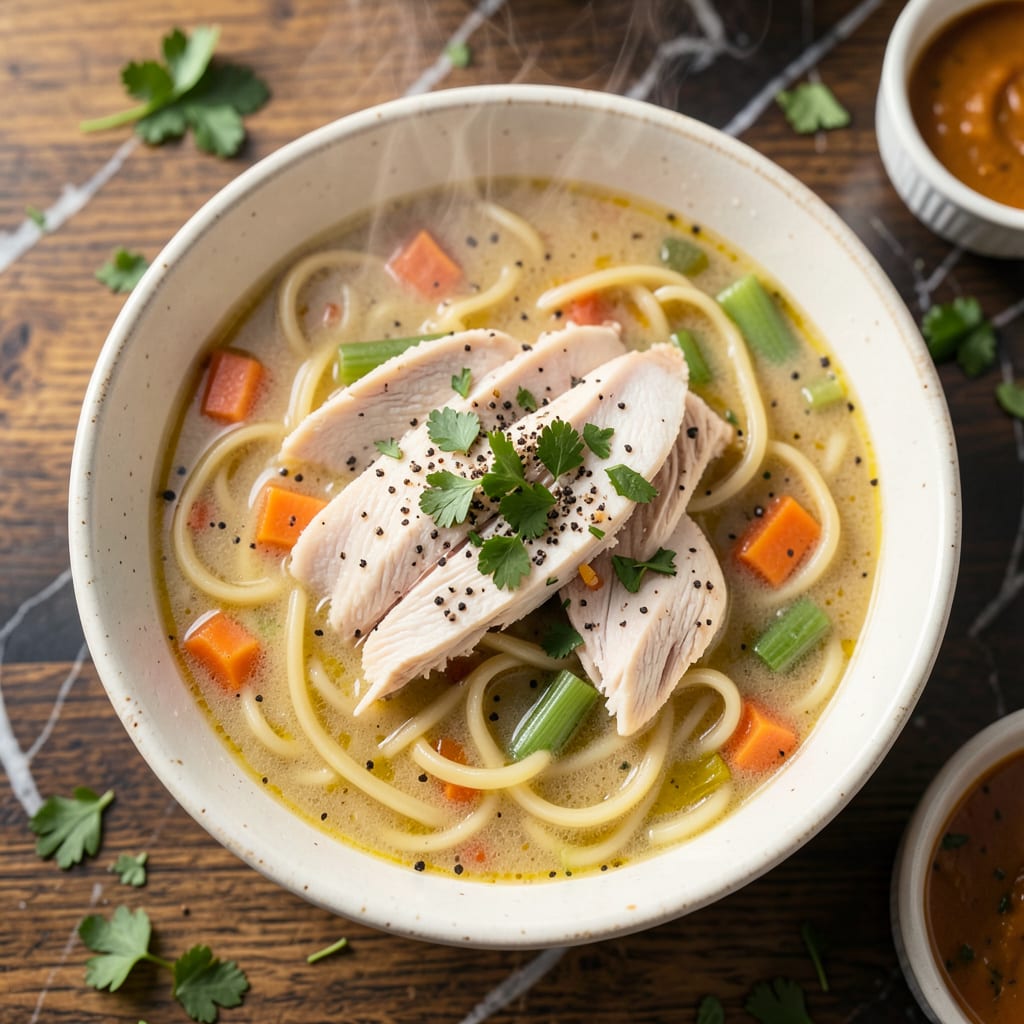
Unopened Costco chicken noodle soup lasts 1-2 years past the printed date. Once opened, it stays fresh 3-4 days in the fridge or 2-3 months frozen. Always check for spoilage signs before consuming.
Costco’s canning process is what gives this soup its impressive shelf life. 🔥 The combination of high-pressure sealing and preservatives creates a sterile environment that prevents bacterial growth for years. Once you break that seal though, oxygen exposure changes everything—refrigeration slows but doesn’t stop microbial activity completely.
I’ve found the freezer becomes your best friend for leftovers. The extreme cold essentially pauses the spoilage clock, but proper portioning is key. Use airtight containers with minimal headspace to prevent freezer burn, and label everything—trust me, you’ll forget what’s in there after a few weeks! ✨
💡 In This Article
- Understanding Costco Soup Shelf Life and Spoilage Risks
- Maximizing Freshness: Storing and Reheating Costco Chicken Noodle Soup
Understanding Costco Soup Shelf Life and Spoilage Risks
Costco’s chicken noodle soup achieves its remarkable unopened shelf life through commercial sterilization. The canning process involves heating the soup to 240-250°F for 3-5 minutes in pressurized retorts, destroying all microorganisms.
This creates a vacuum seal that prevents new bacteria from entering, allowing the soup to remain safe for 18-24 months beyond the printed date when stored in cool, dry conditions.
The preservative system typically includes sodium (about 800-900mg per serving) and sometimes citric acid, which inhibit bacterial growth. Once opened, oxygen exposure activates aerobic bacteria like Pseudomonas that multiply rapidly at refrigerator temperatures. 🔥 These microbes break down proteins in the chicken, creating off-flavors within 3-4 days even when properly refrigerated at 40°F or below.
Freezing dramatically slows this process by reducing water activity. At 0°F, bacterial growth virtually stops, though quality gradually degrades over 2-3 months as ice crystals damage cell structures in the vegetables and chicken. The noodles become increasingly mushy during extended freezing due to starch retrogradation—a process where starch molecules realign into a more rigid structure.
Watch for these spoilage signs before consuming: sour or ammonia-like odors (from protein breakdown), slimy texture on chicken pieces, or any mold growth (especially around the can’s rim or soup surface).
💫 Unlike unopened cans where botulism is the primary concern, opened soup spoilage is typically from common foodborne pathogens like Listeria or Bacillus cereus that thrive in cooked, moist environments.
The pH level of chicken noodle soup (typically 6.0-6.5) makes it particularly vulnerable to spoilage compared to more acidic canned goods. This neutral pH range provides an ideal environment for bacterial growth once the sterile seal is broken.
That’s why proper storage becomes critical after opening—transferring to shallow, airtight containers maximizes cooling efficiency and minimizes oxygen exposure.
Interestingly, the noodles often spoil before the broth. Their high starch content makes them more susceptible to texture changes and microbial growth. 🌟 When reheating frozen soup, you might notice the noodles absorb more liquid—this happens because freezing damages their cell walls, making them more porous during thawing.
For maximum safety, always reheat to 165°F throughout, using a food thermometer to check multiple spots. The USDA recommends consuming refrigerated leftovers within 4 days for optimal safety, though I’ve found Costco’s soup maintains good quality for the full 3-4 day window when stored properly in the coldest part of your fridge.

- Jollof Rice Sauce Recipe: West African Tomato and Spice Infusion - September 25, 2026
- Japanese Rice Soup Recipe: Umami-Rich Comfort in a Bowl - September 25, 2026
- Homemade Cream Of Rice Recipe: Silk-Smooth Breakfast in Minutes - September 25, 2026