
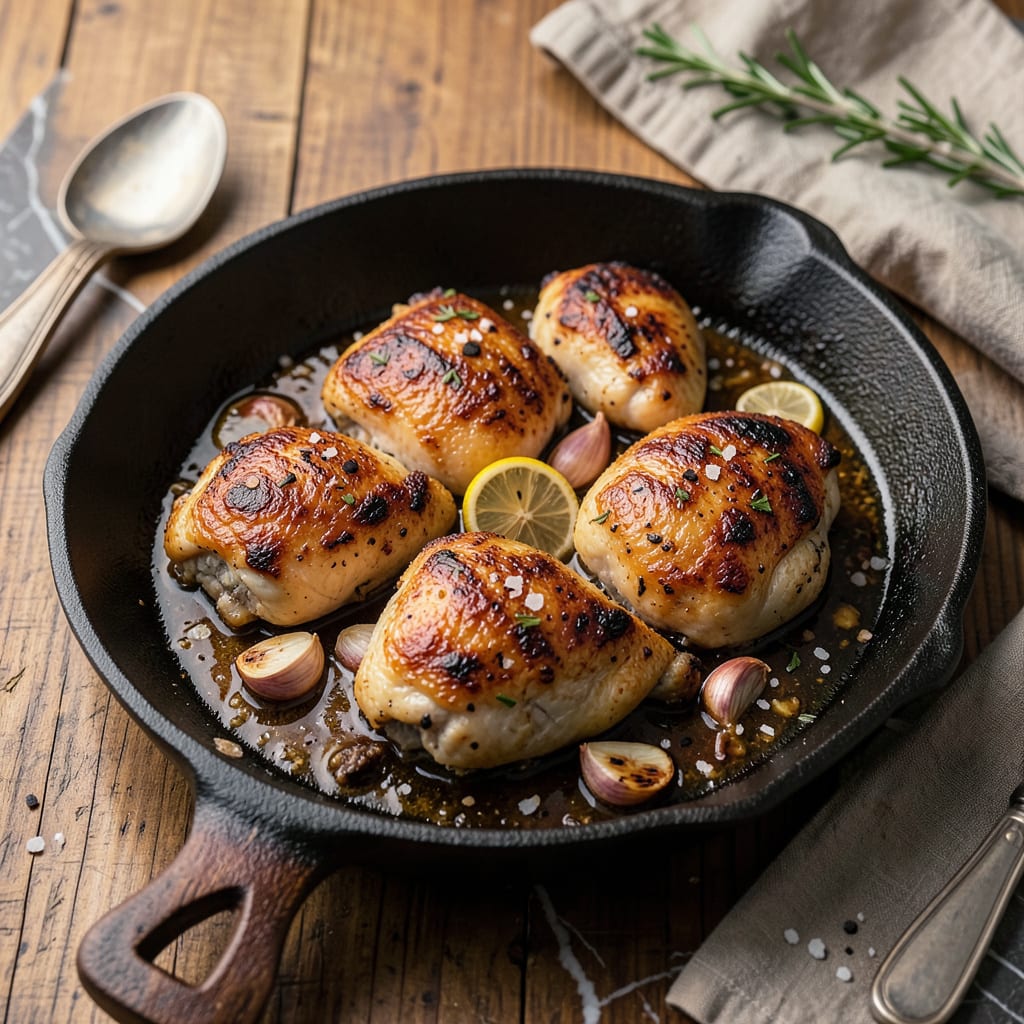
Cook bone-in chicken thighs in a skillet for 12-14 minutes per side over medium-high heat until they reach 175°F internally. Boneless thighs need 6-8 minutes per side at 165°F for juicy results.
The secret to that perfect balance of crispy skin and tender meat lies in understanding how dark meat behaves differently than white meat. 🔥 Bone-in thighs take longer because the bone acts as an insulator, requiring extra time for heat to penetrate fully. I always recommend using a meat thermometer—it’s the only foolproof way to guarantee juiciness without overcooking.
What most home cooks don’t realize is that the Maillard reaction (that beautiful browning process) happens best when the skin makes direct contact with the hot pan. This is why I suggest patting the thighs completely dry before they hit the skillet—it creates that coveted golden crust while locking in moisture. ✨
💡 In This Article
- Why Skillet Cooking Times Vary for Chicken Thighs
- Pro Tips for Perfect Skillet Chicken Thighs Every Time
Why Skillet Cooking Times Vary for Chicken Thighs
The difference between 12-14 minutes for bone-in and 6-8 minutes for boneless thighs comes down to heat conduction. Bones act like insulation—slowing heat transfer to the meat’s center by about 30%. This means the surrounding muscle tissue takes longer to reach safe temperatures.
The thigh’s connective tissue also requires more time to break down properly, which is why rushing this process leads to chewy results.
Dark meat’s higher collagen content demands a final internal temperature of 175°F (versus 165°F for white meat). At this temperature, collagen converts to gelatin, creating that signature juicy texture. The Maillard reaction—responsible for crispy skin—occurs best between 300-350°F. A properly heated skillet maintains this range while allowing gradual internal cooking. 🔥
Pan heat distribution plays a crucial role too. Cast iron skillets retain heat more evenly than stainless steel, reducing hot spots that could cause uneven cooking. I’ve found that medium-high heat (about 375°F) creates the perfect balance: hot enough for crispy skin development while allowing the interior to cook through without burning.
The skin’s direct contact with the pan surface triggers the Maillard reaction, which is why you’ll see that golden-brown color develop after about 5-7 minutes of uninterrupted cooking.
Thickness matters more than you might think. A 1-inch thick boneless thigh will cook through in about 6 minutes per side, while a 1.5-inch thick piece may need 8-9 minutes. This is why using a meat thermometer is non-negotiable—visual cues alone can’t account for these variables.
The USDA’s temperature guidelines exist because dark meat’s higher fat content (about 10-12%) makes it more forgiving than lean breast meat, but still requires precision.
Here’s what most recipes don’t tell you: the resting period after cooking is when the meat’s internal temperature actually rises by 5-10°F. This carryover cooking means you should pull thighs from the pan when they’re 5°F below your target temperature.
During resting, the juices redistribute throughout the muscle fibers, preventing that dreaded pool of liquid on your cutting board when you slice into them. ✨
The skin’s crispiness develops through a two-stage process. First, moisture evaporates from the surface as it heats. Then, at around 300°F, the Maillard reaction begins, creating hundreds of new flavor compounds. This is why you’ll smell that incredible aroma about 3-4 minutes into cooking—it’s the chemical transformation happening in real time.
Maintaining consistent heat is key here; fluctuating temperatures can interrupt this process.
For bone-in thighs, the area near the bone cooks more slowly because bone conducts heat differently than muscle. This creates a temperature gradient within the meat, which is why you’ll sometimes see pink near the bone even when the outer meat reads 175°F.
The bone itself can reach temperatures up to 20°F higher than the surrounding meat, which is why proper cooking times are essential for both safety and texture. 💫

- Jollof Rice Sauce Recipe: West African Tomato and Spice Infusion - September 25, 2026
- Japanese Rice Soup Recipe: Umami-Rich Comfort in a Bowl - September 25, 2026
- Homemade Cream Of Rice Recipe: Silk-Smooth Breakfast in Minutes - September 25, 2026