
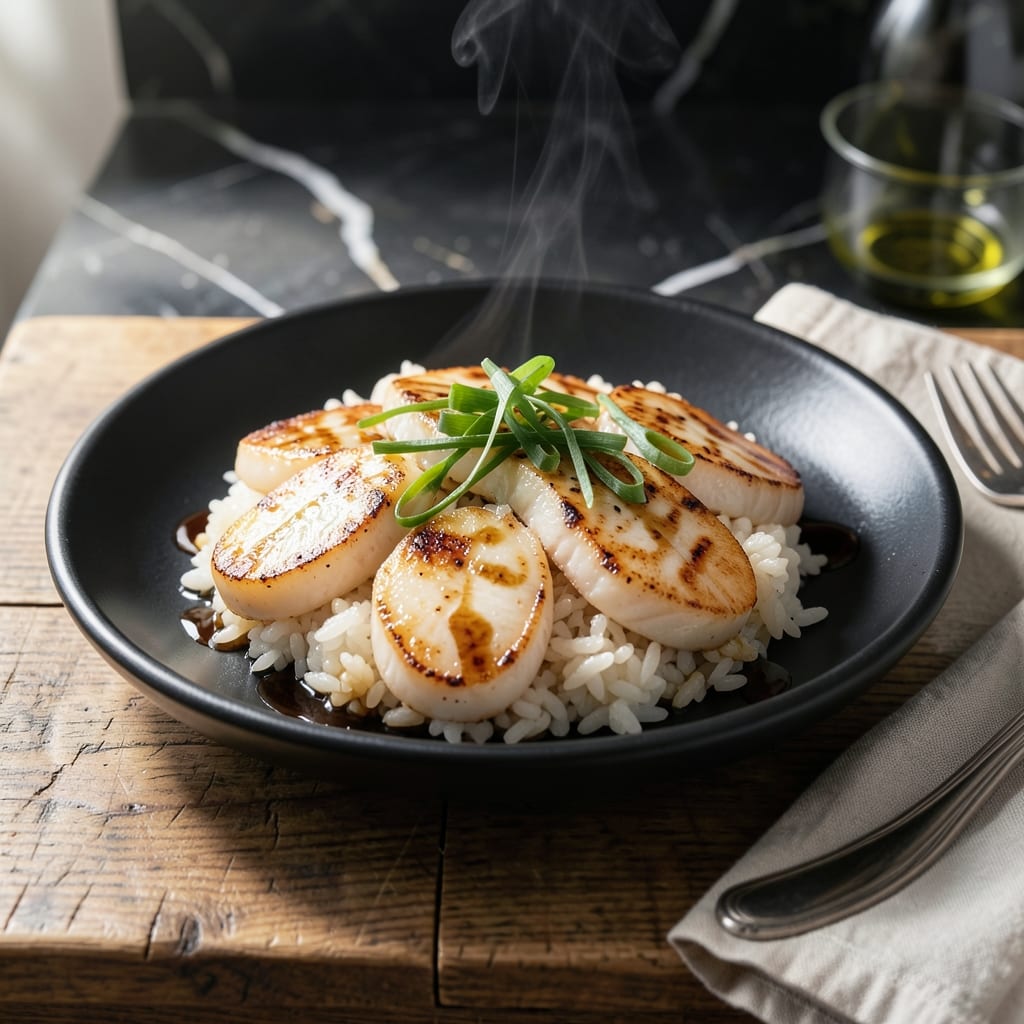
This Japanese scallop rice delivers a perfect balance of sweet, briny depth with every bite. The dish combines tender scallops with fluffy rice, creating a harmony of textures and flavors that feels authentically traditional.
I’ve refined this method to highlight the scallops’ natural sweetness while infusing the rice with umami-rich notes. The key lies in searing the scallops quickly over high heat to preserve their delicate texture before combining them with the rice.
What emerges is a dish that’s both comforting and elegant, with each grain of rice absorbing the scallops’ essence. The result is a savory, aromatic creation that’s simple yet deeply satisfying.
Serve it as a side or a light main for a taste of coastal Japan at home.
Ingredients for Japanese Scallop Rice
Fresh scallops and short-grain rice create this coastal Japanese classic with deep, savory flavor.
| Ingredient | Amount | Notes |
|---|---|---|
| Scallops 🦪 | 1 ½ lb | Fresh, dry-packed, patted dry |
| Japonica Rice 🍚 | 2 cups | Short-grain, rinsed until clear |
| Dashi Stock 🥣 | 2 ½ cups | Homemade or instant dashi powder |
| Sake 🍶 | 2 tbsp | Dry variety preferred |
| Soy Sauce 🫙 | 3 tbsp | Low-sodium for balance |
| Mirin 🍾 | 2 tbsp | Sweet cooking rice wine |
| Vegetable Oil 🫒 | 2 tbsp | High smoke point for searing |
| Green Onions 🧅 | 4 whole | Thinly sliced for garnish |
| Garlic Cloves 🧄 | 3 cloves | Minced finely |
| Fresh Ginger 🌿 | 1 tbsp | Grated or minced |
| Sesame Oil 🫒 | 1 tsp | Toasted, for finishing |
| Nori Sheets 🍱 | 2 sheets | Cut into thin strips |
| Bonito Flakes 🐟 | ¼ cup | Optional for extra umami |
| Sesame Seeds 🌰 | 1 tsp | Toasted for garnish |
The scallops are the star here. Dry-packed sea scallops from a reputable fishmonger or Whole Foods seafood counter are ideal—avoid wet-packed, which release too much moisture. Japonica rice (short-grain) is non-negotiable for that sticky, slightly chewy texture. Look for brands like Koshihikari or Nishiki at Asian markets or well-stocked supermarkets. The dashi forms the flavor base, so use high-quality powder or make your own from kombu and bonito.
No sake? Dry white wine at half the amount works in a pinch. Out of mirin? Mix 1 tbsp sugar with 1 tbsp water per tablespoon needed. The soy sauce can be tamari for gluten-free, but taste first—it’s saltier. If you skip the bonito flakes (for vegetarian), add 1 tsp fish sauce or extra soy sauce for depth. Fresh ginger is best, but ground ginger at one-third the amount is acceptable.
Cook the rice immediately after rinsing—don’t let it soak. Leftovers keep 2-3 days in the fridge, but the scallops are best fresh. Reheat gently with a splash of water to prevent drying. For extra flair, serve with pickled ginger and wasabi on the side.
Why You’ll Love This Recipe
- One Pot Wonder: I love that everything cooks together—just layer scallops, rice, and the dashi-sake-soy broth, then let it steam.
- Umami Bomb: The combo of sweet scallops, salty soy, and savory dashi makes every bite ridiculously good. My kids even ask for the broth-soaked rice at the bottom.
- Weeknight Hero: Honestly, it’s my go-to for busy evenings. Ready in 30 minutes, and leftovers taste just as great the next day.
- Budget Stretcher: Scallops feel fancy, but a few go a long way when paired with rice. I’ll be real: it’s my secret for impressing guests without breaking the bank.
Step-by-Step Instructions for Japanese Scallop Rice
Here’s the method that ensures perfectly seared scallops and fragrant rice every time.
Step 1: Prepare the Japonica Rice Base
Rinse the 2 cups Japonica Rice in a fine-mesh strainer under cold water until the water runs clear. This removes excess starch and prevents gummy rice. Drain thoroughly, then transfer to a rice cooker or heavy pot.
Add the 2.5 cups Dashi Stock, 2 tbsp Sake, 3 tbsp Soy Sauce, and 2 tbsp Mirin. Stir gently to distribute the liquids evenly. The dashi provides a subtle oceanic depth that complements the scallops perfectly.
Step 2: Sear the Scallops to Golden Perfection
Pat the 1.5 lb Scallops completely dry with paper towels—this ensures a good sear rather than steaming. Heat the 2 tbsp Vegetable Oil in a large skillet over medium-high heat until it shimmers but doesn’t smoke.
Add the scallops in a single layer, leaving space between each. Sear undisturbed for 2-3 minutes per side until they develop a golden crust and release easily from the pan. The scallops should be just opaque in the center. Transfer to a plate and set aside.
Step 3: Cook the Rice and Finish the Dish
Start cooking the rice in your rice cooker or on the stovetop. While it cooks, finely mince the 3 cloves Garlic Cloves and grate the 1 tbsp Fresh Ginger. Thinly slice the 4 whole Green Onions on a diagonal for garnish.
When the rice is 80% cooked (about 10 minutes in), gently fold in the seared scallops. This allows them to warm through and infuse the rice with their sweet flavor without overcooking.
Step 4: Garnish and Serve
Once the rice is fully cooked and the scallops are heated through, drizzle with the 1 tsp Sesame Oil. Sprinkle with the sliced Green Onions, 0.25 cup Bonito Flakes, and 1 tsp Sesame Seeds for added texture and umami.
Cut the 2 sheets Nori Sheets into thin strips with scissors and scatter over the top. Serve immediately while hot, with the scallops nestled into the fragrant rice. The nori adds a subtle brininess that ties all the flavors together beautifully.
Pro Tips For Making Japanese Scallop Rice
- Pat Scallops Dry: I learned this the hard way—wet scallops steam instead of sear. Blot them with paper towels until bone-dry before hitting the pan, or they’ll leak water into your rice.
- Pre-Cook the Rice: Use day-old cooked Japonica rice or par-cook fresh rice until just underdone. It soaks up the dashi-sake-soy sauce better without turning mushy.
- Skip Overcrowding: Sear scallops in batches if needed—crowding the pan drops the temperature and turns them rubbery. Give them space to caramelize properly.
- Deglaze with Sake: After searing scallops, pour in a splash of sake to lift those browned bits. Sounds simple, but it adds a depth of flavor that water or broth can’t match.
Essential Equipment for This Recipe
Rice Cooker
A reliable rice cooker is non-negotiable for perfect Japonica rice. I use my Zojirushi Neuro Fuzzy—it maintains precise temperature control and automatically switches to keep-warm mode. The fuzzy logic technology adjusts cooking time and temperature for consistent results every time.
Heavy Skillet
For searing scallops, a heavy-bottomed skillet is essential. My 12-inch Lodge cast iron retains heat beautifully and develops that perfect golden crust. Avoid nonstick pans—they can’t reach the necessary medium-high heat for proper searing. 🔥
Sharp Chef’s Knife
A sharp 8-inch chef’s knife makes quick work of mincing garlic and ginger. I keep mine razor-sharp with a Wüsthof and hone it before each use. A dull knife crushes rather than slices, which can make your aromatics bitter.
Fine-Mesh Strainer
Rinsing rice requires a fine-mesh strainer to prevent grains from washing down the drain. I use a stainless steel one that fits perfectly over my sink. Rinse until the water runs completely clear for fluffy, separate grains.
Wooden Spoon
Gently fold the scallops into the rice with a wooden spoon to avoid breaking them. I prefer a flat-edged spoon that lets me scrape the bottom of the pot without scratching. This preserves the scallops’ delicate texture while distributing them evenly.
Mandoline Slicer
For perfectly even green onion slices, a mandoline is my secret weapon. I use the Benriner model—it’s affordable and razor-sharp. Thin, uniform slices look professional and distribute flavor evenly across the dish. ✨
Nutrition Facts
Frequently Asked Questions
Can I use frozen scallops for this?
Yes, but thaw them overnight in the fridge first. Pat them completely dry before searing to avoid steaming. Never thaw at room temperature, as this can make them mushy.
Why rinse the rice before cooking?
Rinsing removes excess starch, preventing gummy rice. Keep rinsing until the water runs clear for fluffy, separate grains. This step ensures the perfect sticky-yet-light texture.
What if my scallops release too much liquid?
This happens with wet-packed scallops. Pat them extra dry and sear in a very hot pan. If needed, drain excess liquid before adding to rice to avoid soggy results.
Can I make this without a rice cooker?
Use a heavy pot with a tight lid. Cook rice with the same liquid ratios over low heat for 15-20 minutes, then let it steam off-heat.

- Mujadara Rice and Lentils Recipe: Earthy Spiced Lentils With Caramelized Onions - November 1, 2026
- Naija Fried Rice Recipe: Street-Style Spice With Veggie Crunch - November 1, 2026
- Mushy Rice Recipe: Fluffy Grains Transformed in Minutes - November 1, 2026