
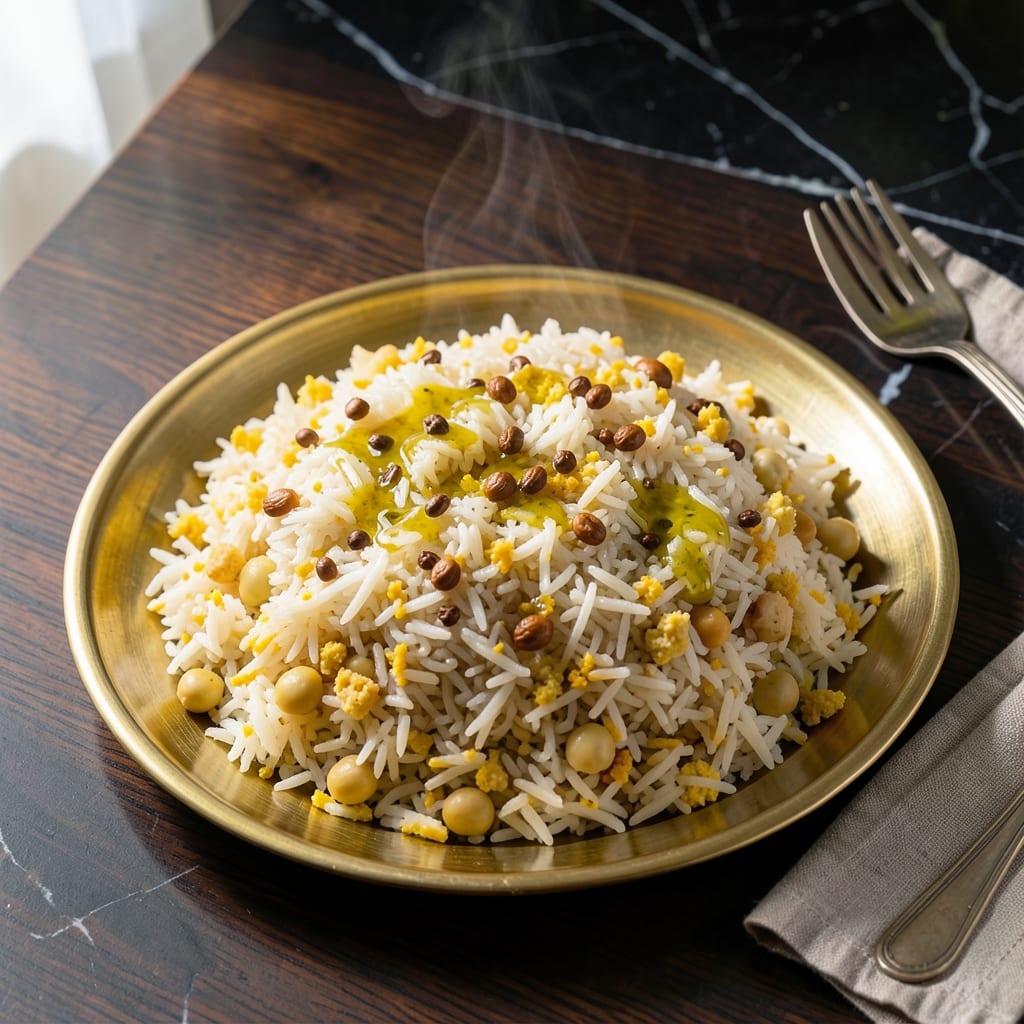
This South Indian classic transforms everyday rice into a festive masterpiece with mixed grains and vibrant flavors.
Traditional kadambam rice combines multiple grains with aromatic spices, creating a dish that’s as nourishing as it is delicious. The careful layering of ingredients builds complex flavors in every bite.
What makes this version special is the balance between texture and taste. Each grain maintains its identity while contributing to the harmonious whole.
The result is a colorful, fragrant dish that brings the spirit of South Indian celebrations to your table.
Ingredients for Kadambam Rice Recipe in Telugu
Everyday rice becomes extraordinary with these layered grains and warm spices.
| Ingredient | Amount | Notes |
|---|---|---|
| Basmati Rice 🍚 | 1 ½ cups | Rinsed and drained thoroughly |
| Raw Rice 🍚 | 1 cup | Short grain preferred |
| Moong Dal 🥜 | ½ cup | Yellow split variety |
| Chana Dal 🥜 | ½ cup | Split chickpeas, soaked |
| Ghee 🧈 | 3 tbsp | Clarified butter, or use coconut oil |
| Mustard Seeds 🌿 | 1 tsp | Black or yellow variety |
| Cumin Seeds 🌿 | 1 tsp | Whole, not ground |
| Green Cardamom Pods 🌿 | 4 pieces | Lightly crushed |
| Cloves 🌿 | 4 pieces | Whole for tempering |
| Cinnamon Stick 🌿 | 1 piece | 2-inch length |
| Bay Leaf 🍃 | 1 piece | Dried or fresh |
| Cashew Nuts 🌰 | ¼ cup | Whole or broken pieces |
| Raisins 🍇 | ¼ cup | Golden or black |
| Fresh Ginger 🌿 | 1 tbsp | Finely grated |
| Green Chilies 🌶️ | 2 pieces | Slit lengthwise |
| Water 💧 | 4 cups | For cooking grains |
| Salt 🧂 | 1 ½ tsp | Adjust to taste |
For authentic flavor, Indian grocery stores are your best bet for the dals and whole spices. Look for fresh, unbroken grains—the moong dal should be bright yellow, chana dal a clean off-white. Ghee is non-negotiable for that rich aroma (I get mine from Patel Brothers), but coconut oil works if you’re avoiding dairy. The cashews and raisins? Whole or broken pieces both work—just avoid the salted kind.
No moong dal? Split pigeon peas (toor dal) can step in. Missing a spice? Skip it but add extra cumin—it carries the dish. For heat control, remove seeds from green chilies. Short on time? Pre-soak the chana dal for 30 minutes. And if you can’t find fresh ginger, ground ginger at half the amount saves the day (just add it with the tempering).
Cooked grains keep in the fridge for 3-4 days—reheat with a splash of water. For longer storage, freeze portions for up to 3 months. Always bring to room temperature before reheating, or the textures get weird.
Why You’ll Love This Recipe
- One Pot Wonder: I toss everything—the basmati, raw rice, both dals, and ghee—into a single pot and let it cook. No fuss, no multiple pans.
- Ghee Richness: The toasted moong and chana dal in ghee give this rice a nutty, deep flavor that’s hard to resist. Honestly, it’s the kind of taste that lingers.
- Feeds a Crowd: Whether it’s a lazy Sunday lunch or a sudden guest visit, this dish stretches easily and satisfies everyone at the table.
- Budget Friendly: A handful of rice, a spoonful of dal, and a drizzle of ghee—that’s all it takes. I’ll be real: it’s filling, delicious, and won’t break the bank.
Step-by-Step Instructions for Kadambam Rice
This traditional method ensures perfectly cooked grains with authentic South Indian flavors.
Step 1: Prepare and Soak the Dals and Rice
Rinse the 1.5 cups Basmati Rice and 1 cup Raw Rice together in a fine-mesh strainer under cold water until the water runs clear. This removes excess starch and prevents the grains from becoming gummy. Drain thoroughly and set aside.
In a separate bowl, combine the 0.5 cup Moong Dal and 0.5 cup Chana Dal. Rinse these under cold water as well, then soak in enough water to cover by 1 inch for 20 minutes. Soaking softens the dals, ensuring they cook evenly with the rice.
Step 2: Temper the Whole Spices and Nuts
Heat the 3 tbsp Ghee in a heavy-bottomed pot or pressure cooker over medium heat. Add the 1 tsp Mustard Seeds and wait for them to pop—this should take about 30-45 seconds. Immediately add the 1 tsp Cumin Seeds, 4 pieces Green Cardamom Pods, 4 pieces Cloves, 1 piece Cinnamon Stick, and 1 piece Bay Leaf.
Stir for 10-15 seconds until the spices release their aroma. Then add the 0.25 cup Cashew Nuts and 0.25 cup Raisins. Sauté until the cashews turn light golden brown and the raisins plump slightly. Be careful not to burn the nuts—they cook quickly in hot ghee.
Step 3: Sauté Aromatics and Toast the Grains
Add the 1 tbsp Fresh Ginger and 2 pieces Green Chilies to the pot. Sauté for 30 seconds until the ginger becomes fragrant. This builds a flavorful base for the dish.
Now add the drained Basmati Rice, Raw Rice, and soaked Moong Dal and Chana Dal (drain the soaking water first). Stir gently to coat the grains in the spiced ghee. Toast for 2-3 minutes until the rice turns slightly translucent at the edges. This step enhances the nutty flavor of the grains.
Step 4: Cook the Kadambam Rice to Perfection
Pour in the 4 cups Water and add the 1.5 tsp Salt. Stir well to combine, ensuring the salt and spices are evenly distributed. Bring the mixture to a rolling boil over medium-high heat.
Once boiling, reduce the heat to low, cover the pot with a tight-fitting lid, and let it simmer for 20-25 minutes. Avoid lifting the lid during this time to prevent steam from escaping. The rice is done when all the water is absorbed and the grains are tender but still distinct. If using a pressure cooker, cook for 3 whistles, then let the pressure release naturally.
Step 5: Rest and Fluff the Grains
Turn off the heat and let the rice rest, covered, for 10 minutes. This allows the grains to steam evenly and absorb any remaining moisture. The Basmati Rice and Raw Rice should be fluffy, while the Moong Dal and Chana Dal should be soft but not mushy.
Gently fluff the kadambam rice with a fork, taking care not to break the grains. The spices should be evenly distributed, and the cashews and raisins should add bursts of texture and sweetness. Serve hot with a side of yogurt or a simple vegetable curry to complement the rich, aromatic flavors.
Pro Tips For Making Kadambam Rice Recipe In Telugu
- Soak the dals: Soak moong dal and chana dal for 20-30 minutes before cooking—this cuts down cooking time and prevents them from turning mushy, which I learned the hard way after a few gummy batches.
- Use aged basmati: Pick aged basmati rice for kadambam; it stays separate and fluffy, while fresh basmati tends to clump, and trust me, the texture difference is worth the extra rupees.
- Low heat for ghee: Heat ghee on low-medium flame when tempering—high heat burns the spices and turns the ghee bitter, and after ruining two batches, I now keep it gentle.
- Mix rice types: Combine basmati and raw rice in a 1:1 ratio for the perfect balance of fragrance and bite—this isn’t traditional but it actually changes the outcome for the better.
Common Mistakes When Making Great kadambam rice recipe in telugu
Skipping the Soak
I learned the hard way that skipping the 20-minute soak for chana dal leads to uneven cooking. The basmati and raw rice finish first while the chana dal stays crunchy. Soak both dals together in warm water to cut this time in half. 💡
Overcrowding the Pot
Using a pot that’s too small causes grains to steam rather than cook evenly. I use a 4-quart heavy-bottomed pot for this recipe. This gives the rice and dals room to expand without sticking.
Also, resist the urge to stir during cooking. This breaks the grains and releases excess starch, making your dish gummy instead of fluffy.
Spice Burning
Tempering spices over high heat burns them before they release their oils. Always use medium heat and watch closely. The mustard seeds should pop within 30-45 seconds—if they don’t, your heat is too low.
Water Ratio Errors
The 4 cups water works perfectly for the grain combination here. Using less makes the dish dry and undercooked. More creates a porridge-like texture. If using a pressure cooker, reduce water to 3.5 cups.
Premature Fluffing
Fluffing immediately after cooking releases all the steam too quickly. I always let it rest 10 minutes covered first. This lets the grains absorb final moisture and set properly.
Use a fork, not a spoon, to fluff. This prevents crushing the delicate grains.
Nutrition Facts
Frequently Asked Questions
Can I use only basmati rice?
No, the mix of grains is essential. The raw rice and dals add texture and nutrition. Stick to the 1.5 cups basmati and 1 cup raw rice ratio for authentic results.
Why soak the dals?
Soaking the moong dal and chana dal for 20 minutes ensures even cooking. Without it, the dals remain hard while the rice overcooks. Warm water speeds up the process.
Can I skip ghee?
Ghee adds rich flavor, but coconut oil works as a substitute. Avoid vegetable oil—it lacks the aromatic depth. Use 3 tbsp of your chosen fat for best results.
How do I prevent mushy rice?
Avoid stirring during cooking and use the exact 4 cups water. Letting it rest 10 minutes after cooking helps grains firm up. Fluff gently with a fork.

- Mujadara Rice and Lentils Recipe: Earthy Spiced Lentils With Caramelized Onions - November 1, 2026
- Naija Fried Rice Recipe: Street-Style Spice With Veggie Crunch - November 1, 2026
- Mushy Rice Recipe: Fluffy Grains Transformed in Minutes - November 1, 2026