
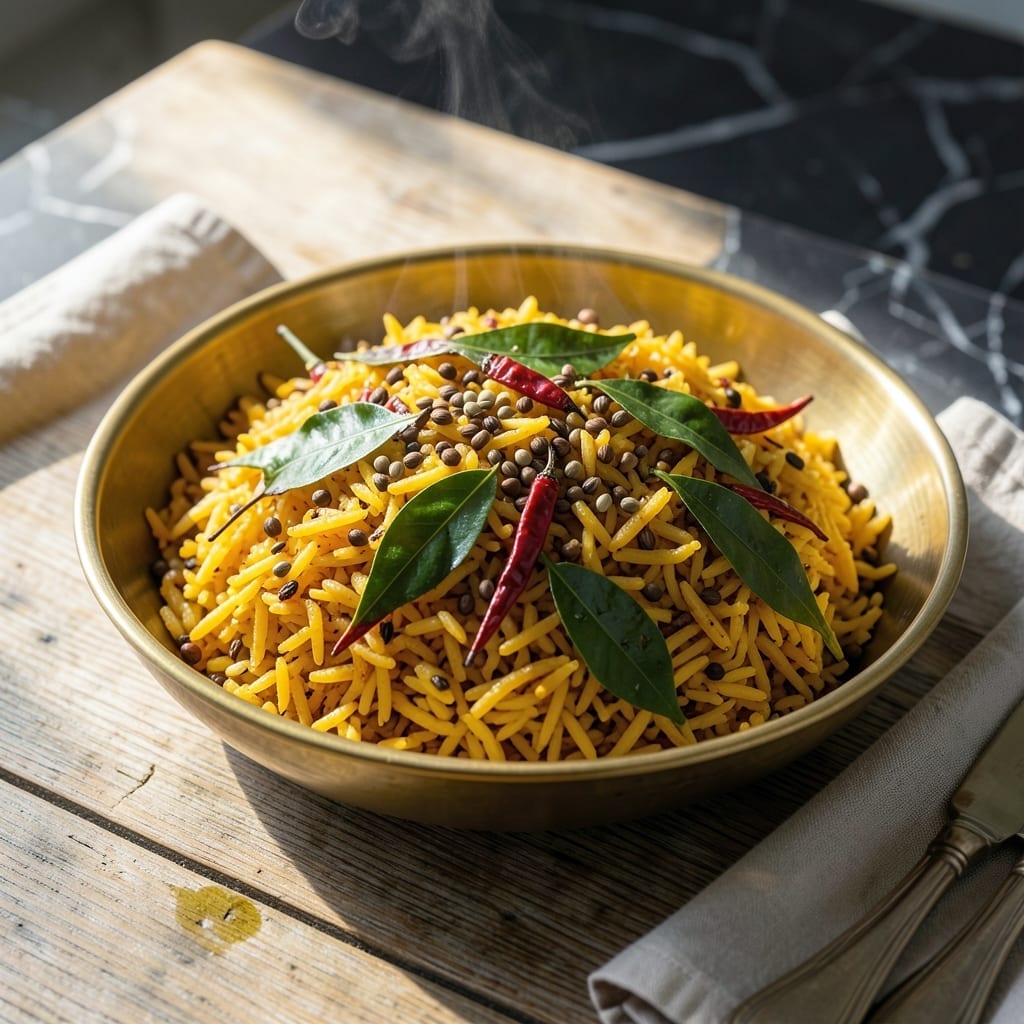
This masala rice delivers bold Indian flavors with minimal effort. The aromatic blend of whole and ground spices transforms ordinary rice into a fragrant, colorful side dish that pairs perfectly with curries or grilled meats.
I developed this method after years of testing ratios and techniques to achieve restaurant-quality results at home. The key is blooming the spices in hot oil before adding the rice, which releases their essential oils and infuses every grain.
You’ll end up with fluffy, perfumed rice with visible specks of cumin, mustard seeds, and curry leaves. The dish comes together in under 30 minutes with basic pantry staples.
Serve it as a simple weeknight side or as part of a festive Indian meal. Here’s how to make it.
Ingredients for Masala Rice
Pantry staples plus a few whole spices. That is all you need here.
| Ingredient | Amount | Notes |
|---|---|---|
| Basmati Rice 🍚 | 2 cups | Rinsed until water runs clear |
| Vegetable Oil 🫒 | 3 tbsp | Neutral flavor, for blooming spices |
| Cumin Seeds 🌿 | 1 tsp | Whole seeds for aroma |
| Mustard Seeds 🌿 | 1 tsp | Yellow or black variety |
| Dried Red Chilies 🌶️ | 2 whole | Broken in half for heat |
| Curry Leaves 🍃 | 10 pieces | Fresh or dried |
| Ground Turmeric 🌿 | ½ tsp | For golden color |
| Ground Coriander 🌿 | 1 tsp | Freshly ground preferred |
| Green Cardamom Pods 🌿 | 4 whole | Lightly crushed |
| Cinnamon Stick 🌿 | 1 piece | 2-inch piece for depth |
| Bay Leaf 🍃 | 1 piece | Dried or fresh |
| Onion 🧅 | 1 whole | Medium, finely chopped |
| Water 💧 | 4 cups | For cooking rice |
| Salt 🧂 | 1 ½ tsp | Adjust to taste |
The spices are non-negotiable for that authentic flavor. Patel Brothers or any Indian grocery will have everything—curry leaves, whole cardamom, the works. Look for bright, fragrant spices (dull color or weak smell means they’re old). I grab my basmati from Trader Joe’s (great quality, good price), but any long-grain rice works. Just rinse it well—this removes excess starch so your grains stay separate.
Missing curry leaves? Asafoetida (hing) at a pinch—just a tiny bit—gives a similar depth (you’ll find it at Indian stores too). No whole spices? Ground versions at half the amount, but toast them first to wake up the flavor. The chilies can be skipped if you’re heat-sensitive, or swapped for a pinch of cayenne. Basmati is ideal, but jasmine rice works in a 1:1.5 rice-to-water ratio instead.
Rice keeps well in the pantry for 6-12 months if stored airtight. Whole spices last even longer—about 2 years. Once opened, store them in cool, dark cabinets (not above the stove). Leftovers? They’ll keep 3-4 days in the fridge and reheat beautifully.
Why You’ll Love This Recipe
- One Pot Wonder: I just dump everything in, let the cumin and mustard seeds sizzle in oil, and the rice cooks right in the same pot.
- Aroma Explosion: The second those red chilies hit the hot oil, the whole kitchen smells like a Mumbai street stall.
- Feeds a Crowd: I make a big batch on Sunday and we’re set for lunches all week—still tastes amazing reheated.
- Pantry Staples: Basmati, oil, a few seeds and chilies. That’s it. Honestly, I always have these on hand.
Step-by-Step Instructions for Masala Rice
Here’s the method. Straightforward, tested, works every time.
Step 1: Rinse and Soak the Basmati Rice
Place the 2 cups Basmati Rice in a fine-mesh strainer and rinse under cold running water until the water runs completely clear. This removes excess starch and prevents the grains from clumping together during cooking.
Once rinsed, transfer the rice to a bowl and cover with cold water. Let it soak for 20-30 minutes. Soaking helps the grains expand evenly, resulting in fluffy, separate rice. Drain thoroughly before cooking—any excess water will throw off your liquid ratio.
Step 2: Bloom the Whole Spices in Hot Oil
Heat the 3 tbsp Vegetable Oil in a large, heavy-bottomed pot over medium heat. Add the 1 tsp Cumin Seeds, 1 tsp Mustard Seeds, 2 whole Dried Red Chilies, 10 pieces Curry Leaves, 4 whole Green Cardamom Pods, 1 piece Cinnamon Stick, and 1 piece Bay Leaf.
Cook for 30-60 seconds until the mustard seeds start to pop and the cumin turns a shade darker. Stir constantly to prevent burning—these spices can go from fragrant to bitter in seconds. The aroma should be intense and intoxicating; that’s how you know they’re ready.
Step 3: Sauté the Onion and Ground Spices
Add the finely chopped 1 whole Onion to the pot and sauté for 5-7 minutes until it turns translucent and begins to soften. The onions should pick up the golden hue from the spices, deepening in color as they cook.
Stir in the 0.5 tsp Ground Turmeric and 1 tsp Ground Coriander, cooking for another 30 seconds to toast the ground spices. This step builds the flavor base that will infuse the rice with warmth and complexity.
Step 4: Cook the Rice with Water and Salt
Add the drained 2 cups Basmati Rice to the pot and stir to coat the grains in the spiced oil and onion mixture. This ensures every bite is packed with flavor. Pour in the 4 cups Water and 1.5 tsp Salt, stirring once to distribute everything evenly.
Bring the mixture to a rolling boil, then reduce the heat to low, cover the pot with a tight-fitting lid, and let it simmer undisturbed for 15-18 minutes. Resist the urge to lift the lid—steam is what cooks the rice perfectly.
Step 5: Rest and Fluff for Perfect Texture
After the cooking time is up, turn off the heat and let the rice sit covered for an additional 5-10 minutes. This resting period allows the grains to steam in their own moisture, becoming tender and fluffy.
Finally, gently fluff the rice with a fork to separate the grains, being careful not to break them. The rice should be light, fragrant, and each grain distinct. Serve hot, garnished with extra curry leaves if you have them on hand.
Pro Tips For Making Masala Rice
- Toast the Seeds: Heat the oil until it shimmers, then add cumin and mustard seeds—wait for the mustard seeds to pop before adding anything else. I learned this the hard way after a few batches where the spices tasted raw.
- Rinse the Rice: Soak basmati rice for 20 minutes, then rinse until the water runs clear. This removes excess starch so your masala rice stays fluffy, not gluey.
- Tame the Chilies: Break dried red chilies in half before frying to release flavor, but remove them before serving if you want heat without the crunch.
- Low Heat Simmer: Once the rice and water are in, drop to the lowest heat and cover tightly—no peeking for at least 12 minutes. After burning two pots, I finally accepted that patience wins here.
Essential Equipment for This Dish
Heavy-Bottomed Pot
A 3-4 quart heavy-bottomed pot or Dutch oven is essential for even heat distribution. I use my Le Creuset for this—the thick base prevents hot spots that can burn your spices. Thin pots may cause uneven cooking and burnt flavors. 🔥
Fine-Mesh Strainer
For rinsing the 2 cups Basmati Rice, a fine-mesh strainer is a must to remove all starch effectively. I prefer the OXO Good Grips model—it fits perfectly over my sink and the handle stays cool. This small tool makes a big difference in achieving fluffy grains.
Wooden Spoon
Stirring the blooming spices requires a sturdy wooden spoon. It won’t scratch your pot and can handle the high heat. I keep a 12-inch bamboo spoon dedicated to my Indian cooking—it’s perfect for stirring without breaking delicate whole spices like cardamom pods.
Tight-Fitting Lid
Steam is crucial for perfect rice, so your pot needs a tight-fitting lid. Glass lids let you peek without releasing steam, but a heavy metal lid works too. I’ve found that stainless steel lids create the best seal for this dish.
Chef’s Knife
For finely chopping the 1 whole Onion, a sharp 8-inch chef’s knife is ideal. I use my Wüsthof—it makes quick work of the onion and maintains precision. A dull knife can crush the onion, releasing too many juices and affecting the texture. 💡
Rice Cooker Option
While traditional stovetop works best, a multi-cooker like the Instant Pot can simplify the process. Use the sauté function for blooming spices, then pressure cook for 6 minutes with a 10-minute natural release. The results are nearly identical with less hands-on time.
Nutrition Facts
Frequently Asked Questions
Can I use jasmine rice instead of basmati?
Yes, but adjust the water ratio to 1:1.5. Jasmine rice is stickier, so results will differ slightly from basmati’s fluffy texture.
Why do I need to soak the rice first?
Soaking for 20-30 minutes ensures even expansion and prevents clumping. It’s the secret to perfectly separated, fluffy grains every time.
What if I don’t have whole spices?
Use ground spices at half the amount, but toast them first. While not ideal, ground cumin and coriander can work in a pinch.
How do I store leftovers?
Keep in an airtight container in the fridge for 3-4 days. Reheat with a splash of water to restore moisture.

- Jollof Rice Sauce Recipe: West African Tomato and Spice Infusion - September 25, 2026
- Japanese Rice Soup Recipe: Umami-Rich Comfort in a Bowl - September 25, 2026
- Homemade Cream Of Rice Recipe: Silk-Smooth Breakfast in Minutes - September 25, 2026