
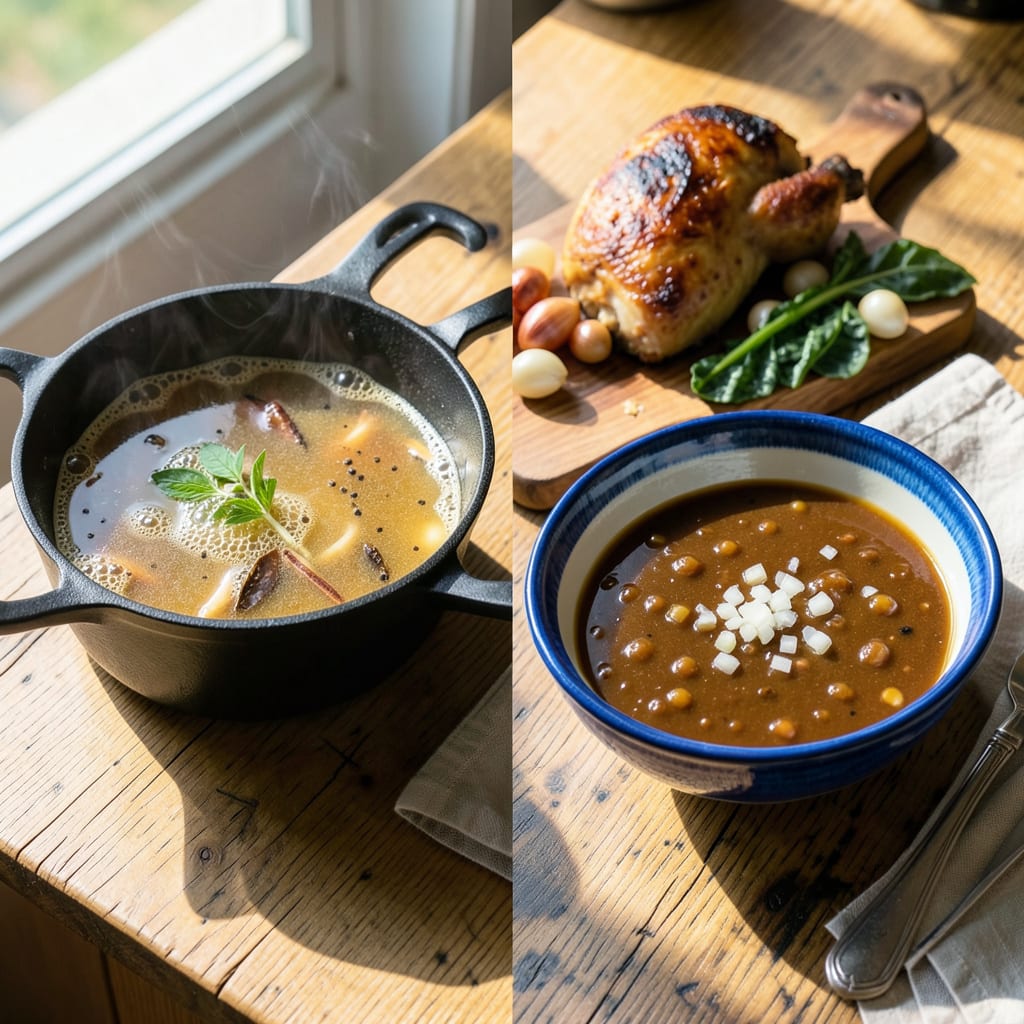
Yes, you can reuse chicken broth once if properly handled—boil it for at least 3 minutes to kill bacteria, then cool and refrigerate within 2 hours. Avoid reusing more than once, as flavor weakens and contamination risks rise.
I always think of broth reuse as a one-time opportunity to stretch your ingredients without compromising safety. The key lies in that 3-minute rolling boil—it’s your insurance policy against lingering pathogens like salmonella. 🔥 What many don’t realize is that each reheat cycle degrades the collagen and gelatin that give broth its body, leaving you with a thinner, less satisfying base. That’s why I treat reused broth as a flavor enhancer rather than a standalone ingredient, perfect for deglaing pans or cooking grains where its subtler profile can still shine.
💡 In This Article
- Food Safety Risks of Reusing Chicken Broth
- How to Maximize Flavor When Reusing Chicken Broth
Food Safety Risks of Reusing Chicken Broth
Reheating chicken broth creates a perfect storm for bacterial growth because it’s a protein-rich environment that pathogens love. The main culprits—Salmonella and Campylobacter—can double their numbers every 20 minutes in the “danger zone” between 40°F and 140°F.
That’s why the 3-minute rolling boil is non-negotiable: it raises the internal temperature to 212°F, killing 99.9% of common bacteria. But here’s the catch—this only works if you maintain that boil continuously. 🔥
The 2-hour cooling rule isn’t arbitrary—it’s based on how quickly bacteria can multiply. After boiling, broth must drop from 212°F to below 40°F within this window. I use an ice bath to accelerate this: place the pot in cold water and stir occasionally.
This prevents the “temperature linger” effect where broth sits too long in that dangerous middle range. Properly cooled broth can then be refrigerated for 3-4 days or frozen for up to 3 months. ⚡
Each reuse compounds contamination risks exponentially. The first reheat might be safe with proper handling, but the second cycle introduces new variables: residual bacteria from utensils, cross-contamination from storage containers, and degraded proteins that bacteria feed on more easily. Think of it like photocopying a photocopy—the quality (and safety) degrades with each generation.
That’s why professional kitchens never reuse broth more than once. 💫
Storage temperature matters more than most realize. Your fridge should maintain 38-40°F—any warmer and you’re giving bacteria a head start. I always use a thermometer to check my fridge’s actual temperature (many run warmer than their dials indicate). For freezer storage, portion broth in 1-cup measurements in airtight containers to minimize temperature fluctuations during thawing.
✨
The physical changes in reused broth also signal safety concerns. Notice how it becomes cloudier? That’s denatured proteins clumping together—these provide more surface area for bacteria to cling to. The flavor shift from rich umami to flat or sour is another red flag.
When in doubt, remember: no amount of boiling can reverse the textural breakdown or fully eliminate all potential toxins some bacteria produce. 🌟
Consider the source of your original broth too. Homemade versions from raw chicken carry higher initial bacterial loads than commercially prepared, pasteurized broths. That’s why I always strain my homemade broth through a fine-mesh sieve lined with cheesecloth before the first use—it removes more impurities that could become breeding grounds for bacteria during storage.
This extra step buys you more safety margin for that one allowed reuse. ⚡
The bottom line: treat reused broth like you would raw chicken in terms of handling precautions. Use separate utensils, avoid letting it sit at room temperature, and never combine new broth with leftover broth—this cross-contamination is how foodborne illness outbreaks start in home kitchens.
When you understand the microbial battlefield you’re navigating, those safety steps make perfect sense. 💛

- Jollof Rice Sauce Recipe: West African Tomato and Spice Infusion - September 25, 2026
- Japanese Rice Soup Recipe: Umami-Rich Comfort in a Bowl - September 25, 2026
- Homemade Cream Of Rice Recipe: Silk-Smooth Breakfast in Minutes - September 25, 2026