
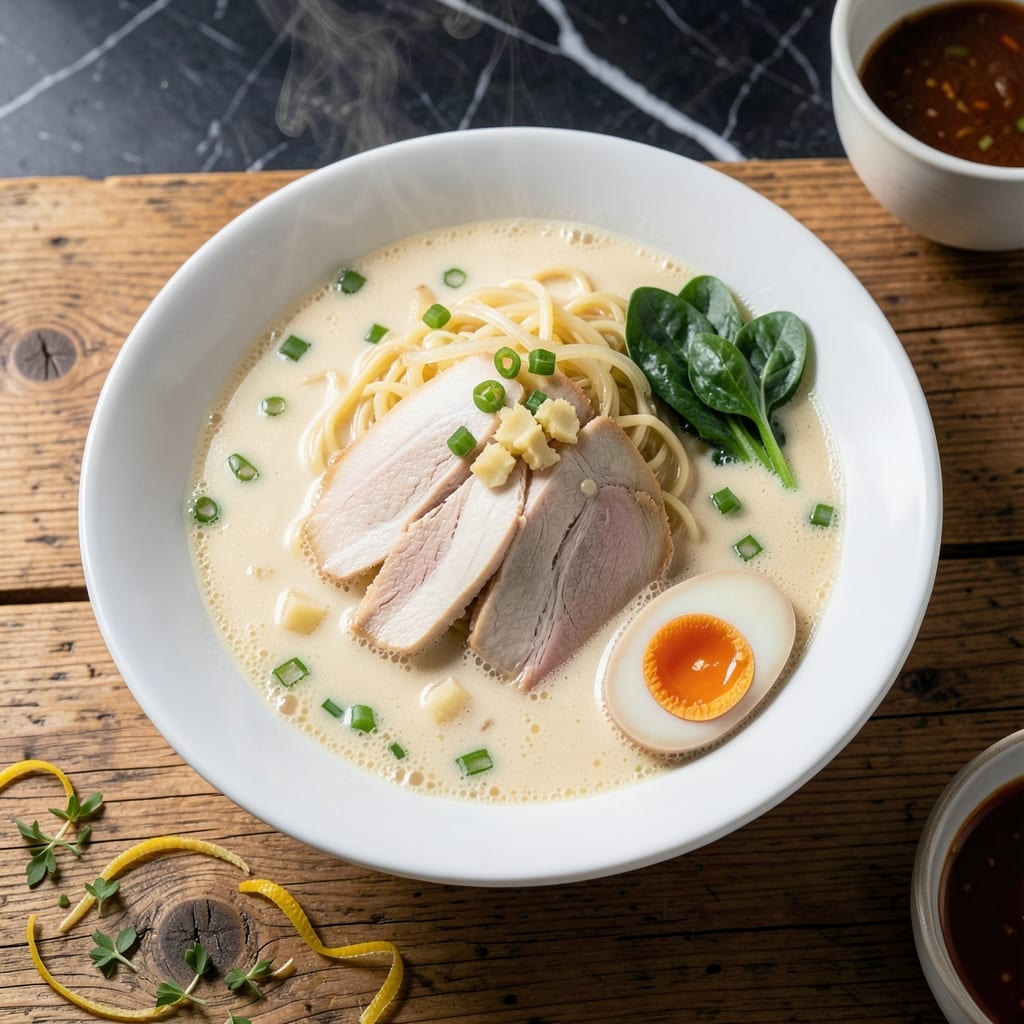
Rich, velvety chicken paitan ramen delivers restaurant-quality depth with a surprisingly simple technique. The milky broth, created through long simmering of chicken bones and aromatics, forms the soul of this dish.
I developed this method to capture authentic Japanese flavor without requiring specialty ingredients. The key is patience—allowing the broth to reduce slowly draws out maximum collagen and gelatin for that signature creamy texture.
Each bowl combines silky noodles, tender chashu chicken, and soft-boiled eggs in the umami-packed broth. The result is a comforting yet sophisticated meal that impresses without overwhelming.
Serve with traditional toppings like menma bamboo shoots and nori for the complete experience.
Ingredients for Chicken Paitan Ramen
Authentic Japanese ingredients create restaurant-quality ramen with velvety, milky broth depth at home.
| Ingredient | Amount | Notes |
|---|---|---|
| Chicken Bones 🍗 | 4 lb | Feet and neck preferred for collagen |
| Chicken Thighs 🍗 | 1 lb | Bone-in, skin-on for chashu |
| Yellow Onions 🧅 | 2 whole | Roughly chopped, skin on |
| Garlic Cloves 🧄 | 8 cloves | Smashed, skin on |
| Fresh Ginger 🌿 | 1 piece | 4-inch, sliced thick |
| Green Onions 🧅 | 1 bunch | White and green parts separated |
| Dried Shiitake Mushrooms 🍄 | 4 pieces | For umami depth |
| Kombu Seaweed 🌊 | 2 sheets | 4×4 inch pieces |
| Ramen Noodles 🍜 | 4 packages | Fresh or dried, cooked separately |
| Large Eggs 🥚 | 4 whole | For soft-boiled eggs |
| Menma Bamboo Shoots 🌱 | ½ cup | Canned or vacuum-packed |
| Nori Sheets 🌊 | 4 sheets | Cut into strips for topping |
| Soy Sauce 🫒 | ¼ cup | Low-sodium preferred |
| Mirin 🍶 | 2 tbsp | Sweet rice wine |
| Sesame Oil 🫒 | 1 tsp | Toasted, for finishing |
| White Pepper 🌶️ | ½ tsp | Ground, for broth |
The chicken bones are non-negotiable for authentic paitan. Feet and necks (ask your butcher at Whole Foods or local Asian markets) yield the most collagen for that signature creamy texture. Kombu and shiitake are the umami workhorses—look for dried shiitake with thick caps, and kombu that’s glossy, not dusty. The bones should be raw, not pre-cooked, to extract maximum gelatin.
No chicken feet? Pig trotter at half the quantity works (though it changes the flavor slightly). Fresh shiitake can substitute dried, but use double the amount since they’re less concentrated. Mirin missing? 1 tbsp sugar + 1 tbsp dry sherry mimics the sweetness. For the noodles, Sun Noodle brand (sold frozen at H Mart) is the gold standard, but any fresh ramen noodles will do.
Broth can be made 2 days ahead—it actually improves as it sits. Store bones and aromatics in the fridge until ready to cook. Finished broth keeps 5 days refrigerated or 3 months frozen. Soft-boiled eggs peel best when shocked in ice water immediately after cooking.
Why You’ll Love This Recipe
- Set and Forget: I toss the chicken bones and thighs into the pot with onions, garlic, and ginger, then let the slow simmer do all the work.
- Rich, Creamy Broth: The collagen from the bones breaks down into this velvety, milky broth that coats every noodle perfectly.
- Meal Prep Dream: I make a big batch on Sunday and it reheats beautifully for quick lunches all week.
Step-by-Step Instructions for Chicken Paitan Ramen
Master the technique for a rich, milky broth that delivers authentic depth of flavor.
Step 1: Par-Blanch the Chicken Bones and Thighs
Place the 4 lb Chicken Bones and 1 lb Chicken Thighs in a large stockpot and cover with cold water. Bring to a boil over high heat, then reduce to a simmer for 10 minutes. This step removes impurities that could cloud your broth.
Drain and rinse both the bones and thighs under cold water, scrubbing them gently to remove any scum. This blanching process is essential for achieving the signature clean, white color of paitan broth while maintaining pure chicken flavor.
Step 2: Build the Broth Base with Aromatics
Return the blanched bones and thighs to the stockpot. Add 2 whole Yellow Onions, 8 cloves Garlic Cloves, 1 piece Fresh Ginger, 4 pieces Dried Shiitake Mushrooms, and 2 sheets Kombu Seaweed.
Cover with 4 quarts of cold water and bring to a boil over high heat. Once boiling, reduce to a rolling simmer. Skim off any foam that rises to the surface during the first 30 minutes—this ensures crystal-clear broth.
Step 3: Simmer for Collagen Extraction
Maintain a gentle simmer for 8-10 hours, partially covered. The long cooking time extracts collagen from the chicken bones, creating the characteristic milky, creamy texture. Stir occasionally and add water as needed to keep the bones submerged.
After 2 hours, remove the chicken thighs to use for chashu later. Continue simmering the bones with the aromatics until the broth develops a rich, opaque white appearance and deeply savory aroma.
Step 4: Strain and Season the Broth
Strain the broth through a fine-mesh sieve into a clean pot, pressing gently on the solids to extract all liquid. Discard the spent bones and aromatics. Return the broth to the stove over medium heat.
Add 0.25 cup Soy Sauce, 2 tbsp Mirin, and 0.5 tsp White Pepper. Simmer for 10 minutes to meld the flavors. Taste and adjust seasoning if needed—the broth should be well-balanced but not overpowering.
Step 5: Assemble the Ramen Bowls
Cook the 4 packages Ramen Noodles according to package instructions, then drain. Divide the noodles among four bowls. Ladle the hot broth over the noodles.
Top each bowl with soft-boiled Large Eggs, 0.5 cup Menma Bamboo Shoots, separated Green Onions, and strips of Nori Sheets. Finish with a drizzle of 1 tsp Sesame Oil for aromatic depth. Serve immediately while piping hot.
Pro Tips For Making Chicken Paitan Ramen
- Parboil the Bones: I learned this the hard way—blanch the chicken bones for 10 minutes first to remove impurities, or your broth will turn murky instead of that beautiful milky white paitan color.
- Char the Aromatics: Toss your onions, garlic, and ginger directly on a dry, hot pan until blackened in spots—this adds depth to the broth that raw aromatics just can’t.
- Skip the Rolling Boil: After the initial boil, drop to a gentle simmer; a rolling boil emulsifies too much fat and can make your broth greasy instead of rich.
- Use Thighs for Collagen: Chicken thighs break down faster than breasts and release more collagen, which is what gives paitan that creamy, velvety texture—worth the extra 30 minutes of simmering.
Serving Suggestions for This chicken paitan ramen
Bowl Presentation
Start with a deep, wide ceramic ramen bowl—the classic white with blue rim really makes the colors pop. Arrange the noodles in a loose nest shape at the bottom, creating peaks for broth to cascade over. This simple step makes each bowl look professionally plated. 🔥
Egg Placement
Slice your soft-boiled eggs in half lengthwise and place them gently on one side of the bowl, yolk facing upward. The runny yolk will mix into the broth as you eat, adding richness. I always position them at 3 o’clock for a balanced visual.
Topping Arrangement
Create a diagonal line of toppings from the egg: menma bamboo shoots first, then nori strips, ending with green onions. This Japanese “sanban” (three-section) arrangement is traditional and pleasing to the eye. Leave some broth visible between toppings.
Finishing Touches
Drizzle ½ tsp sesame oil in a zigzag pattern over the toppings. Add a sprinkle of toasted sesame seeds for texture. For extra flair, place a thin slice of chashu chicken on top of the egg, letting it drape slightly into the broth.
Serving Temperature
Serve immediately while the broth is at its hottest—the aroma of chicken paitan is most pronounced just after ladling. The noodles should be piping hot but not scalding. I use tongs to arrange noodles and a ladle for the broth to maintain precision.
Accompaniments
Offer chili oil or extra soy sauce on the side for customization. Provide small spoons for sipping broth between noodle bites. A pot of hot green tea complements the meal perfectly, cleansing the palate between bites. ✨
Nutrition Facts
Frequently Asked Questions
Why does the broth turn milky white?
The long 8-10 hour simmer extracts collagen from chicken bones, particularly feet and necks. This collagen breaks down into gelatin, creating the signature creamy, opaque appearance. Skimming impurities during the first 30 minutes keeps it clean.
Can I use an Instant Pot instead of stovetop?
Yes, but the texture differs. Cook on high pressure for 3 hours for good collagen extraction. The broth won’t be as concentrated or velvety as the traditional method, but it’s a time-saver.
What if my broth isn’t creamy enough?
Simmer longer—the magic happens in the final 2-3 hours. If short on time, add 1 lb extra chicken feet or ½ cup powdered gelatin to boost the milky texture.

- Jollof Rice Sauce Recipe: West African Tomato and Spice Infusion - September 25, 2026
- Japanese Rice Soup Recipe: Umami-Rich Comfort in a Bowl - September 25, 2026
- Homemade Cream Of Rice Recipe: Silk-Smooth Breakfast in Minutes - September 25, 2026