
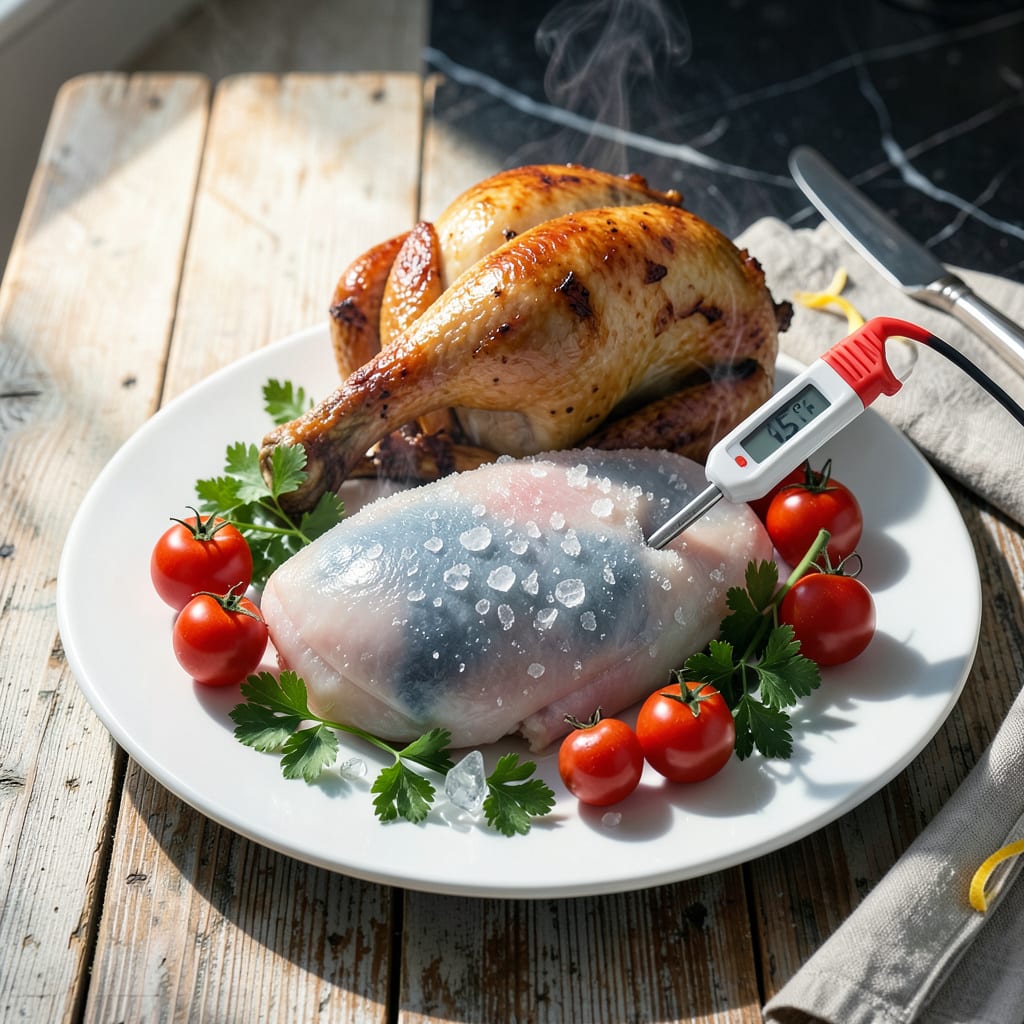
No, leaving frozen chicken out overnight is unsafe. The USDA warns that raw poultry left at room temperature for over 2 hours (or 1 hour if above 90°F) enters the danger zone (40°F–140°F), risking rapid bacterial growth like Salmonella or Campylobacter.
This isn’t just about spoilage—it’s about foodborne illness prevention. 🔥 The danger zone temperatures create the perfect environment for bacteria to multiply exponentially, turning safe-to-eat poultry into a health hazard within hours. I’ve seen cases where people mistakenly assume their kitchen is “cool enough” overnight, not realizing that even 60°F can support dangerous bacterial growth. The risk becomes even higher in summer months or warm climates where room temperatures climb above 70°F.
What many don’t realize is that frozen chicken begins thawing unevenly at room temperature. 💫 The outer layers reach the danger zone long before the center thaws, creating a bacterial breeding ground on the surface while the inside remains frozen. This partial thawing makes it particularly risky compared to other foods that might thaw more uniformly.
💡 In This Article
- Why Overnight Thawing of Frozen Chicken Is Dangerous
- Safe Ways to Thaw Frozen Chicken Overnight
Why Overnight Thawing of Frozen Chicken Is Dangerous
The danger lies in what scientists call the “temperature danger zone” between 40°F and 140°F. At these temperatures, bacteria like Salmonella and Campylobacter multiply exponentially—doubling every 20 minutes in ideal conditions. Your kitchen counter typically sits around 68-72°F, creating perfect breeding grounds for these pathogens.
What starts as a few harmless bacteria can become millions overnight, turning your chicken into a health hazard. 🔥
Here’s what’s actually happening at the microscopic level: As the chicken thaws, ice crystals melt and release moisture that was trapped in the muscle fibers. This moisture creates a thin film on the surface—essentially a bacterial soup.
The USDA found that poultry left at room temperature for 4 hours can develop enough bacteria to cause food poisoning, with some strains producing toxins that aren’t destroyed by cooking. Even if the center remains frozen, the outer layers become contaminated. 💫
The risk isn’t theoretical—CDC data shows that 1 in 6 Americans get food poisoning annually, with poultry being a leading cause. Salmonella alone causes about 1.35 million infections yearly, with symptoms ranging from severe stomach cramps to hospitalization. Campylobacter is even more common, often causing bloody diarrhea and fever.
These bacteria don’t just make you sick—they can lead to long-term health complications like reactive arthritis. ✨
Temperature fluctuations make overnight thawing particularly risky. As your home cools at night, the chicken’s surface temperature might drop slightly, but it rarely goes below 50°F—still well within the danger zone. This partial cooling creates a false sense of security while allowing bacteria to continue multiplying.
Studies show that poultry left out for 6+ hours has a 90% higher contamination rate than properly thawed chicken. 🌟
What most people don’t realize is that freezing doesn’t kill bacteria—it just puts them into dormancy. As the chicken thaws, these bacteria wake up and immediately start reproducing. The USDA’s Food Safety Inspection Service found that 66% of foodborne illness outbreaks from poultry could be prevented with proper thawing methods.
The overnight counter method violates all food safety principles by giving bacteria both time and ideal temperatures to multiply uncontrollably. ⚡
Consider this comparison: Proper refrigerator thawing at 40°F keeps bacterial growth to a minimum, with populations doubling every 6-8 hours instead of every 20 minutes. That’s why the USDA recommends this method—it gives you control over the thawing process while minimizing risk.
The difference between safe and dangerous thawing comes down to temperature control and time management. 💛
The bottom line? That overnight counter thaw might save you 30 minutes of planning, but it could cost you days of illness—or worse. Food safety isn’t about being overly cautious; it’s about understanding how invisible dangers multiply when we give them the right conditions.
Your health isn’t worth the convenience of cutting corners on proper thawing methods. ✨

- Jollof Rice Sauce Recipe: West African Tomato and Spice Infusion - September 25, 2026
- Japanese Rice Soup Recipe: Umami-Rich Comfort in a Bowl - September 25, 2026
- Homemade Cream Of Rice Recipe: Silk-Smooth Breakfast in Minutes - September 25, 2026