
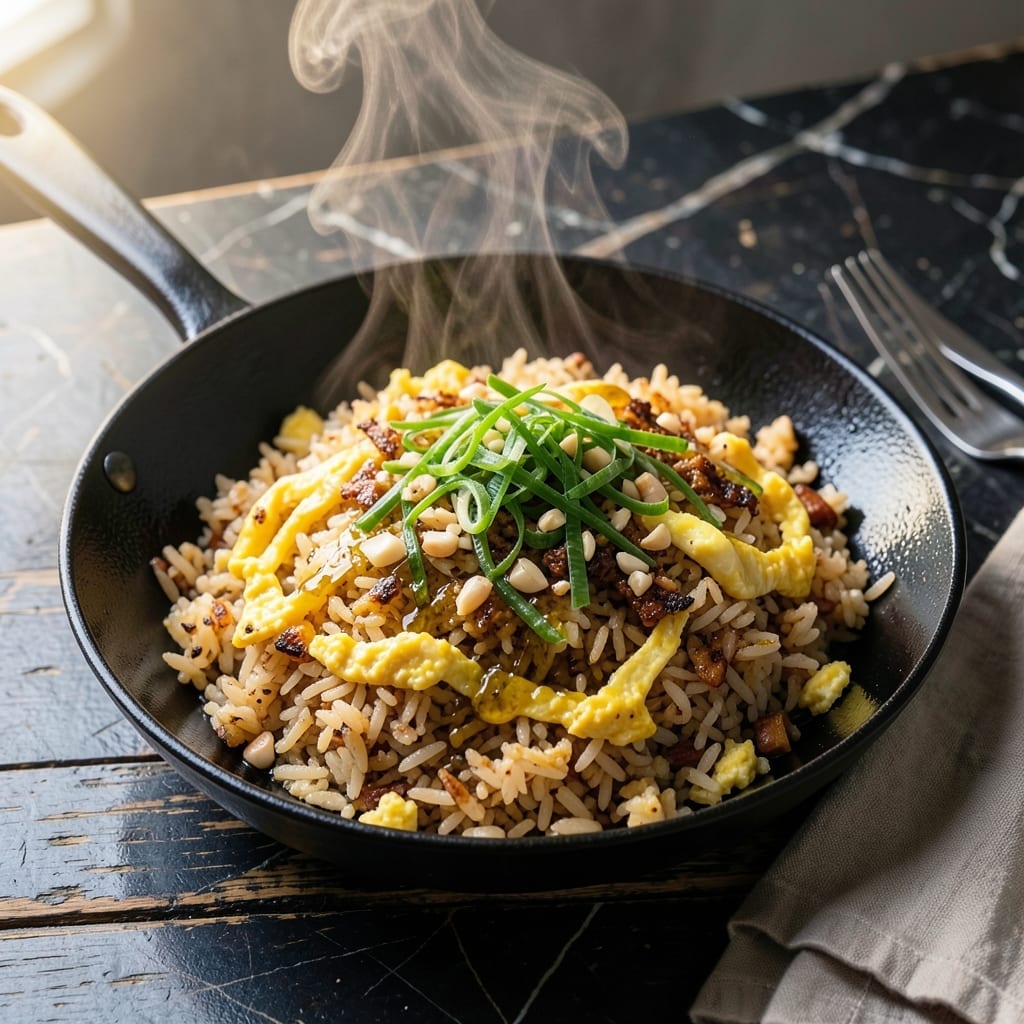
This recipe transforms leftover rice into a wok-tossed masterpiece with bold umami depth and garden-fresh brightness. The technique relies on high heat and precise timing to achieve that signature smoky flavor.
Every bite delivers tender grains, vibrant vegetables, and layers of savory complexity. The dish comes together quickly once you master the rhythm of tossing and seasoning in the wok.
Ingredients for Eric Huang Fried Rice
Transform leftover rice with vibrant vegetables and savory sauces for authentic wok-tossed depth.
| Ingredient | Amount | Notes |
|---|---|---|
| Day-Old Cooked Rice 🍚 | 4 cups | Cold, preferably overnight |
| Large Eggs 🥚 | 3 whole | Beaten, room temperature |
| Peanut Oil 🫒 | 3 tbsp | High smoke point essential |
| Garlic Cloves 🧄 | 4 cloves | Minced finely |
| Fresh Ginger 🌿 | 1 tbsp | Minced or grated |
| Green Onions 🧅 | 4 whole | Thinly sliced, whites and greens separated |
| Carrots 🥕 | 1 whole | Small dice, uniform pieces |
| Frozen Green Peas 🌱 | 1 cup | Thawed, patted dry |
| Light Soy Sauce 💧 | 2 tbsp | Low-sodium preferred |
| Dark Soy Sauce 💧 | 1 tsp | For color depth |
| Sesame Oil 🫒 | 1 tsp | Toasted variety for aroma |
| Oyster Sauce 🍚 | 1 tbsp | Vegetarian alternative if needed |
| White Pepper 🌶️ | ½ tsp | Freshly ground for complexity |
| Salt 🧂 | ½ tsp | Diamond Crystal kosher preferred |
The rice is critical here. Day-old, cold rice with distinct grains prevents mushiness—fresh rice releases too much starch. Jasmine or long-grain white are ideal. For the oyster sauce, Kikkoman or Lee Kum Kee offer consistent quality. Peanut oil’s high smoke point handles the aggressive heat without burning. Find these at any Asian grocery or well-stocked supermarket.
No oyster sauce? Vegetarian oyster sauce or hoisin works in a pinch. Swap carrots for bell peppers if preferred. Frozen peas can be replaced with corn or edamame. For gluten-free, use tamari instead of soy sauce. The green onions add freshness—don’t skip them, but chives work if that’s what you’ve got.
Leftover fried rice keeps 3-4 days refrigerated in an airtight container. Reheat in a skillet with a splash of water to revive texture. For best results, cool completely before storing. Freezing isn’t recommended—the rice loses its signature chew.
Why You’ll Love This Recipe
- One Pan Meal: I love that this comes together in a single wok—just the rice, eggs, and aromatics with minimal cleanup.
- Garlic-Ginger Magic: The combo of fresh ginger and garlic in peanut oil gives it that warm, savory depth you crave.
- Leftover Hero: Day-old rice actually works better here, so I always make extra the night before.
- Budget Friendly: Peanut oil and pantry staples keep costs low, and it stretches to feed a crowd.
Step-by-Step Instructions for Wok-Tossed Umami Fried Rice
Master these techniques to achieve perfectly textured fried rice with authentic wok hei flavor.
Step 1: Prepare and Heat the Wok
Begin by heating a well-seasoned wok over high heat until it just begins to smoke. Add 2 tbsp Peanut Oil and swirl to coat the surface evenly. The oil should shimmer but not burn—this indicates the optimal temperature for searing.
Immediately add the 4 cups Day-Old Cooked Rice, breaking up any clumps with your spatula. Cold rice is essential here; fresh rice would turn mushy. Press the rice against the hot wok surface for 30 seconds to achieve slight charring.
Step 2: Create the Aromatic Foundation
Push the rice to one side of the wok and add the remaining 1 tbsp Peanut Oil to the cleared space. Add the 4 cloves minced Garlic Cloves and 1 tbsp Fresh Ginger, stirring constantly for 15-20 seconds until fragrant but not browned.
Incorporate the small-diced Carrots next, stir-frying for 1-2 minutes until the edges begin to soften. The goal is to develop flavor without overcooking—the carrots should retain a slight bite. Add the thawed Frozen Green Peas and the white portions of the 4 whole Green Onions.
Step 3: Scramble and Integrate the Eggs
Create a well in the center of the wok and pour in the 3 whole beaten Large Eggs. Let them sit undisturbed for 10 seconds to begin setting, then vigorously scramble with your spatula until just set but still slightly runny.
Immediately fold the scrambled eggs into the rice mixture, ensuring even distribution. The residual heat will finish cooking the eggs while coating each grain of rice with silky egg ribbons.
Step 4: Season and Finish with Precision
Drizzle the 2 tbsp Light Soy Sauce, 1 tsp Dark Soy Sauce, and 1 tbsp Oyster Sauce evenly over the rice. The dark soy sauce adds depth of color while the oyster sauce provides umami richness. Toss everything together for 1-2 minutes until the rice is uniformly coated.
Finish with the 1 tsp Sesame Oil, 0.5 tsp White Pepper, and 0.5 tsp Salt. Add the green portions of the Green Onions and toss for an additional 30 seconds until everything is thoroughly combined and heated through. The sesame oil should be added last to preserve its delicate aroma.
Step 5: Rest and Serve Immediately
Transfer the fried rice to a serving platter and let it rest for 2 minutes. This brief pause allows the flavors to meld completely while the rice achieves its final texture.
Serve hot, garnished with any remaining green onion tops. Each grain should be distinct yet coated with sauce, with visible flecks of egg, vegetables, and a subtle sheen from the oils. The final dish should have a balance of savory, slightly sweet, and aromatic notes with a satisfying chew.
Pro Tips For Making Eric Huang Fried Rice
- Crank the Heat: Use the highest heat your stove can handle—peanut oil has a high smoke point, and this is the only way to get that signature wok hei flavor Eric Huang’s recipe demands.
- Dry the Rice: Spread your day-old rice on a tray and let it sit uncovered for 10 minutes before cooking. I learned this the hard way—wet rice steams instead of frying, and you’ll end up with a sad, mushy mess.
- Scramble Eggs First: Push the scrambled eggs to one side of the pan after cooking, then add the garlic and ginger to the empty space. This keeps the eggs from overcooking while the aromatics bloom in the oil.
- Skip Fresh Rice: Sounds obvious, but I’ve seen people try it—fresh rice is too moist and sticky. Day-old, cold rice from the fridge is non-negotiable for that perfect, separate grain texture.
Storing and Reheating eric huang fried rice
Refrigerator Storage
Let your fried rice cool completely before transferring to airtight containers. I use glass containers with snap-tight lids. Store in the fridge at 40°F or below for up to 3-4 days. The flavors deepen overnight as the sauces meld with the rice. ❄️
Freezing Not Recommended
While you can freeze fried rice for up to 1 month, I don’t recommend it. The rice loses its signature chewy texture and becomes mushy upon thawing. The vegetables also turn limp and lose their vibrant color.
Skillet Reheating
My preferred method: heat a nonstick skillet over medium heat, add 1-2 tbsp water or broth, then spread the fried rice in a thin layer. Cover and heat for 3-4 minutes, stirring occasionally. This revives the texture beautifully. 🔥
Microwave Reheating
For quick meals, microwave individual portions covered with a damp paper towel. Heat on 70% power for 1-2 minutes, stir, then continue in 30-second bursts until hot. Add a splash of soy sauce to refresh the flavor.
Reviving Texture
If your reheated fried rice seems dry, sprinkle 1-2 tsp water over it and toss in a hot wok for 1 minute. This brings back the moisture and that coveted wok-tossed texture. The rice should look glossy and separate easily.
Nutrition Facts
Frequently Asked Questions
Why use day-old rice for this dish?
Day-old rice has lower moisture content and distinct grains, preventing mushiness. Fresh rice releases too much starch and turns sticky when stir-fried.
Can I substitute the oyster sauce?
Yes! Use vegetarian oyster sauce or hoisin sauce for similar umami depth. Both work well in a 1:1 ratio.
What if my wok isn’t well-seasoned?
Use a nonstick skillet instead, but preheat it over medium-high heat first. Avoid metal utensils to protect the coating.
How do I prevent soggy fried rice?
Cook over high heat and avoid overcrowding the wok. Spread ingredients thinly and stir-fry in batches if needed.

- Cream of Wild Rice Soup Recipe: Earthy Grains in Silky Broth - October 9, 2026
- Filipino Garlic Rice Recipe: Crispy Fried Aroma With Every Bite - October 9, 2026
- Gobi Manchurian Rice Recipe: Indo-Chinese Fusion in One Bowl - October 9, 2026