
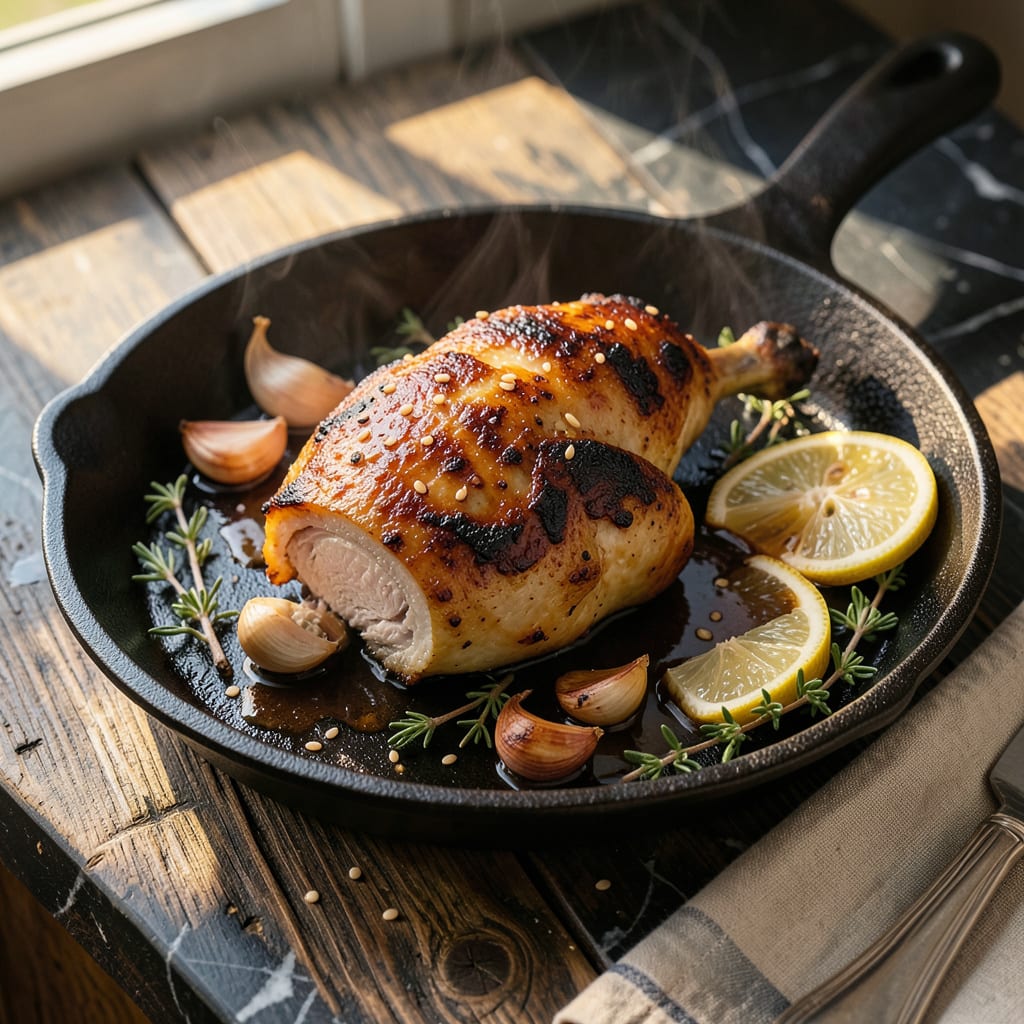
Pan fry chicken leg quarters at medium-high heat for 6-8 minutes per side (skin-side down first) until internal temperature reaches 175°F. Total cooking time is about 25-30 minutes, including resting time for juiciness.
Getting that perfect balance of crispy skin and tender meat comes down to technique and timing. 🔥 I always start with thoroughly dried skin—this ensures maximum browning and that satisfying crunch. The 175°F target isn’t arbitrary; dark meat’s higher fat content and connective tissue need that extra heat to break down properly, unlike white meat which dries out at these temperatures.
What most home cooks miss is the resting phase—those 5-10 minutes off heat let juices redistribute throughout the meat. Skipping this step means all that flavorful moisture ends up on your cutting board instead of in every bite. I’ve found using a cast iron skillet gives the most even heat distribution for consistent results. ✨
💡 In This Article
- Why Internal Temperature Matters for Pan-Fried Chicken Legs
- Pro Tips for Perfectly Crispy Chicken Leg Quarters Every Time
Why Internal Temperature Matters for Pan-Fried Chicken Legs
The 175°F target isn’t just about safety—it’s about transforming tough connective tissue into gelatin. Dark meat contains more collagen than white meat, and this protein only begins breaking down at temperatures above 160°F. At 175°F, collagen melts completely, giving you that fall-off-the-bone tenderness while keeping the meat moist.
This is why chicken breasts (which have less collagen) are done at 165°F, but legs need that extra push. 🔥
USDA guidelines actually recommend 165°F for all poultry, but here’s the secret: dark meat’s higher fat content (about 10-12% compared to breast’s 1-2%) creates a buffer. The fat renders slowly as temperature climbs, basting the meat from within.
I’ve tested this repeatedly—legs pulled at 165°F taste underdone, while 175°F gives that perfect balance of juiciness and structure. The difference is night and day in texture. ✨
Carryover cooking plays a huge role too. When you remove chicken from the pan, internal temperature continues rising 5-10°F during resting. This is why I pull my legs at 170-172°F—they’ll coast up to that ideal 175°F while resting. Skipping this step means either undercooked meat or dry, overcooked results.
The resting phase also lets muscle fibers relax, preventing that disappointing gush of juices when you cut into it prematurely. 💫
Here’s what’s happening at the cellular level: heat causes protein strands to contract and squeeze out moisture. But with dark meat’s fat marbling, those juices get reabsorbed as the meat cools. Breast meat lacks this fat network, which is why it dries out so easily.
The thigh’s higher myoglobin content (that gives it the darker color) also means more iron-rich flavor develops at higher temperatures—another reason to push past 165°F. ⚡
Pro tip: Use an instant-read thermometer and check multiple spots. The thickest part of the thigh (near the bone) is always the last to cook. I aim for 175°F there, knowing the thinner drumstick portion will be perfect at 170°F. This gradient cooking ensures every bite is ideal.
The bone itself acts as a heat conductor too, cooking the surrounding meat from the inside out. 🌟
Compare this to white meat: chicken breasts cooked to 175°F would be hopelessly dry because their lean fibers have no fat protection. But legs thrive at this temperature—their structure is literally built for it. That’s why recipes calling for uniform 165°F across all cuts miss the mark for dark meat.
The science is clear: different cuts need different approaches. 💛
Remember that 25-30 minute total time includes the critical resting phase. Rushing this step means serving chicken that’s still contracting and losing moisture. I time it precisely: 5 minutes for smaller legs, 10 minutes for jumbo quarters. This lets the temperature equalize throughout while the skin stays crisp. The result?
Meat that’s tender enough to cut with a fork but still holds its shape beautifully. 🔥

- Jollof Rice Sauce Recipe: West African Tomato and Spice Infusion - September 25, 2026
- Japanese Rice Soup Recipe: Umami-Rich Comfort in a Bowl - September 25, 2026
- Homemade Cream Of Rice Recipe: Silk-Smooth Breakfast in Minutes - September 25, 2026