
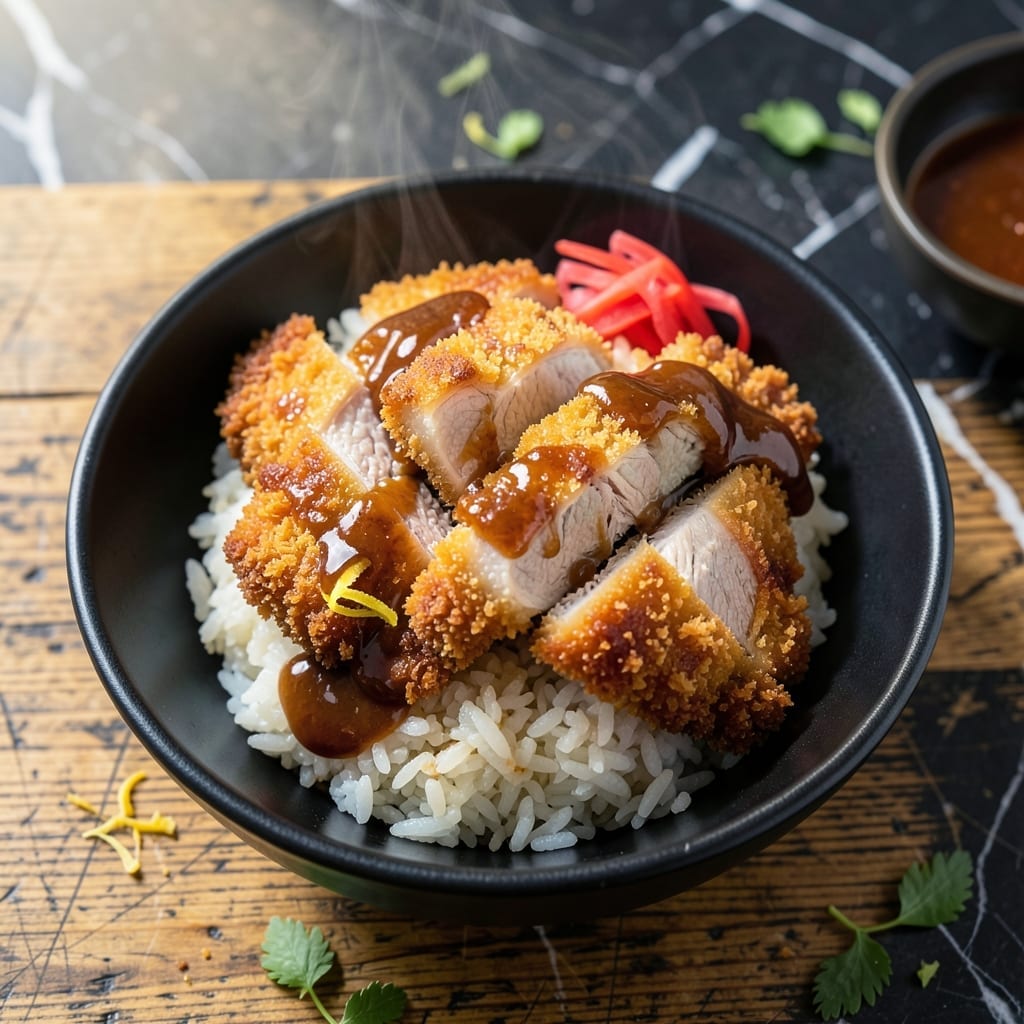
This Japanese pork rice bowl delivers crispy tonkatsu-style cutlets over steamed rice, a dish that balances texture and flavor perfectly. The secret lies in the double-frying technique for maximum crunch without drying the meat.
I’ve refined this method to ensure the pork stays juicy inside while developing a golden, shatteringly crispy breading. The hot oil and precise timing are what set this apart from standard fried cutlets.
Served over fluffy rice with a drizzle of tangy tonkatsu sauce, this dish brings restaurant-quality results to your kitchen. The contrast between the tender pork and the crunchy exterior makes every bite satisfying.
With simple ingredients and careful attention to detail, this recipe proves that homemade can rival your favorite Japanese takeout. The key is patience and precision in the frying process.
Ingredients for Japanese Pork Rice Bowl
A handful of pantry staples and fresh pork create this satisfying Japanese classic at home.
| Ingredient | Amount | Notes |
|---|---|---|
| Pork Loin Chops 🥩 | 1 ½ lb | Boneless, 1/2-inch thick |
| All-Purpose Flour 🌾 | ½ cup | For initial coating |
| Large Eggs 🥚 | 2 whole | Beaten for breading |
| Panko Breadcrumbs 🍞 | 2 cups | Japanese-style for extra crunch |
| Neutral Oil 🫒 | 4 cups | For deep-frying (peanut or vegetable) |
| Long-Grain White Rice 🍚 | 2 cups | Uncooked, rinsed before cooking |
| Tonkatsu Sauce 🍯 | ½ cup | Store-bought or homemade |
| Green Cabbage 🥬 | ¼ whole | Thinly shredded for topping |
| Kewpie Mayonnaise 🥛 | ¼ cup | For serving (optional) |
| Salt 🧂 | 1 tsp | Divided for seasoning |
| Black Pepper 🌶️ | ½ tsp | Freshly ground preferred |
| Garlic Powder 🧄 | ½ tsp | For pork seasoning |
| Onion Powder 🧅 | ½ tsp | For pork seasoning |
| Soy Sauce 🍶 | 1 tbsp | For tonkatsu sauce base |
| Ketchup 🍅 | ¼ cup | For tonkatsu sauce |
The pork is the foundation—boneless loin chops with visible marbling ensure juiciness. Costco or Whole Foods carry quality cuts, but any well-stocked supermarket works. Panko breadcrumbs are non-negotiable for that signature crunch (find them in the Asian aisle at Kroger). For the oil, peanut or vegetable oil handles high heat without smoking. Look for Kewpie mayonnaise in the international section—it’s the authentic choice.
No pork loin? Pork shoulder cutlets work but need thinning to 1/2-inch. Out of panko? Regular breadcrumbs plus 1 tsp cornstarch mimics the texture. Fresh out of tonkatsu sauce? Mix 3 tbsp ketchup + 1 tbsp soy sauce + 1 tbsp Worcestershire (add a dash of sugar if you like). The cabbage can be subbed with shredded lettuce or iceberg for a milder flavor.
Pork keeps in the fridge for 2-3 days before cooking (use it fresh if possible). Fried cutlets stay crispy for 20 minutes after cooking—serve immediately. Leftover rice? Store it separately and reheat with a splash of water. The tonkatsu sauce keeps for 1 week refrigerated.
Why You’ll Love This Recipe
- One Pan Wonder: I love that I only need a single skillet and a bowl for the breading—pork loin chops dusted in flour, dipped in egg, then coated in panko, all fried in neutral oil.
- Crispy Perfection: Here’s what sold me—that golden panko crust stays crunchy even over rice, while the pork stays juicy inside.
- Weeknight Hero: Honestly, it’s my go-to for busy evenings—ready faster than takeout and way more satisfying.
- Budget Stretcher: Pork loin chops are affordable, and a little goes a long way when served over rice with simple toppings.
Step-by-Step Instructions for Japanese Pork Rice Bowl
Here’s the method to achieve that signature crispy cutlet and perfectly balanced flavor profile.
Step 1: Season and Bread the Pork Loin Chops
Pat the pork loin chops dry with paper towels, then season both sides with ½ tsp salt, ½ tsp black pepper, ½ tsp garlic powder, and ½ tsp onion powder. This dry rub creates a flavorful base and helps the breading adhere.
Set up a breading station with three shallow dishes. Place the 0.5 cup all-purpose flour in the first, beat the 2 whole large eggs in the second, and put the 2 cups panko breadcrumbs in the third. Dredge each chop in flour, shaking off excess, then dip in egg, and finally press into panko until fully coated.
Let the breaded chops rest for 10 minutes on a wire rack. This resting period helps the coating set, preventing it from falling off during frying.
Step 2: Deep-Fry the Pork to Golden Perfection
Heat the 4 cups neutral oil in a deep, heavy-bottomed pot to 350°F. Use a thermometer for accuracy—oil that’s too cool will make the cutlets greasy, while too hot will burn the breading before the pork cooks through.
Carefully lower one or two chops at a time into the hot oil, using tongs to avoid splashing. Fry for 4-5 minutes per side until deep golden brown and the internal temperature reaches 145°F. The pork should be cooked through with juices running clear.
Transfer the fried chops to a wire rack set over a baking sheet to drain excess oil. Don’t stack them, as this will trap steam and make the breading soggy. Keep warm in a 200°F oven while frying the remaining chops.
Step 3: Cook the Rice and Prepare the Toppings
Rinse the 2 cups long-grain white rice under cold water until the water runs clear. This removes excess starch and prevents sticky rice. Cook according to package instructions or in a rice cooker with a 1:1.5 rice-to-water ratio.
While the rice cooks, thinly shred the ¼ whole green cabbage using a sharp knife or mandoline. For the tonkatsu sauce, combine the ½ cup tonkatsu sauce, 1 tbsp soy sauce, and ¼ cup ketchup in a small bowl and mix well.
Step 4: Assemble the Pork Rice Bowls
Divide the cooked rice among four bowls. Slice the fried pork loin chops into ½-inch thick strips and arrange them over the rice. The pork should be crispy on the outside and tender on the inside.
Top each bowl with a generous portion of shredded cabbage. Drizzle with the prepared tonkatsu sauce and, if desired, add a spoonful of ¼ cup kewpie mayonnaise for extra creaminess.
Serve immediately while the pork is still crispy and the rice is hot. The combination of textures and flavors—crunchy breading, juicy pork, and the sweet-savory sauce—makes this dish irresistible.
Pro Tips For Making Japanese Pork Rice Bowl
- Pound the Pork: Flatten those loin chops to an even 1/2-inch thickness with a meat mallet or rolling pin—I learned this the hard way after my first batch cooked unevenly with dry spots.
- Chill the Coating: Pop your floured, egg-dipped, and panko-crusted cutlets in the fridge for 10 minutes before frying. Sounds weird, but it works: the coating stays put and crisps up like a dream.
- Skip the Crowding: Fry one cutlet at a time in about 1/2 inch of oil, even if it takes longer. After burning three batches, I finally figured out that overcrowding drops the temperature and turns panko into a sad, soggy mess.
- Rest Before Slicing: Give the fried pork a solid 5 minutes on a wire rack before slicing—my grandmother swore by this, and she was right: it keeps the juices where they belong, in the meat, not on your cutting board.
Dietary Considerations for japanese pork rice bowl
Gluten-Free Adaptations
Swap the all-purpose flour for rice flour and use gluten-free panko breadcrumbs (I recommend Kikkoman brand). The texture stays remarkably similar, and the crispiness remains intact. Just ensure your tonkatsu sauce is labeled gluten-free, as some brands contain wheat.
Lower-Carb Options
Replace the long-grain white rice with cauliflower rice for a lighter version. Sauté 4 cups riced cauliflower in 1 tbsp oil for 5-6 minutes until tender. The dish still satisfies with the same crispy pork and tangy sauce. 💪
Dairy-Free Considerations
This recipe is naturally dairy-free, but check your Kewpie mayonnaise label—some versions contain egg yolks processed in facilities with dairy. For strict dairy avoidance, use vegan mayo like Hellmann’s Vegan instead.
Egg-Free Substitutions
For the breading, replace the 2 beaten eggs with ½ cup unsweetened almond milk mixed with 1 tbsp cornstarch. This creates a similar binding effect. The panko will still adhere beautifully, and the final texture remains crispy.
Low-Sodium Adjustments
Reduce the salt in the seasoning to ¼ tsp and use low-sodium soy sauce in the tonkatsu sauce. You can also make a homemade sauce with no-salt-added ketchup and skip the soy sauce entirely. The pork’s natural flavor shines through. 💡
Pescatarian Alternative
Swap the pork for firm tofu slices or shrimp. Press and drain 1 lb extra-firm tofu for 30 minutes, then bread and fry as directed. For shrimp, use 1 lb large shrimp, peeled and butterflied, with the same breading process.
Nutrition Facts
Frequently Asked Questions
Can I use pork shoulder instead of loin?
Yes, but thin it to ½-inch for even cooking. Shoulder has more fat, which can make the breading soggy if not fully cooked through. Loin is ideal for its leanness and tenderness.
Why rest the breaded chops before frying?
Resting for 10 minutes helps the coating adhere better. This prevents the breading from falling off during frying and ensures a crispier finish. Skipping this step risks uneven texture.
Can I bake instead of deep-fry?
Bake at 400°F for 15-20 minutes, flipping halfway. It won’t be as crispy, but it’s a healthier option. Use a wire rack on a baking sheet for even air circulation.
How do I keep the pork crispy while serving?
Fry just before serving and keep warm in a 200°F oven on a wire rack. Avoid stacking or covering, as steam will soften the breading. Serve immediately for best texture.

- Jollof Rice Sauce Recipe: West African Tomato and Spice Infusion - September 25, 2026
- Japanese Rice Soup Recipe: Umami-Rich Comfort in a Bowl - September 25, 2026
- Homemade Cream Of Rice Recipe: Silk-Smooth Breakfast in Minutes - September 25, 2026