
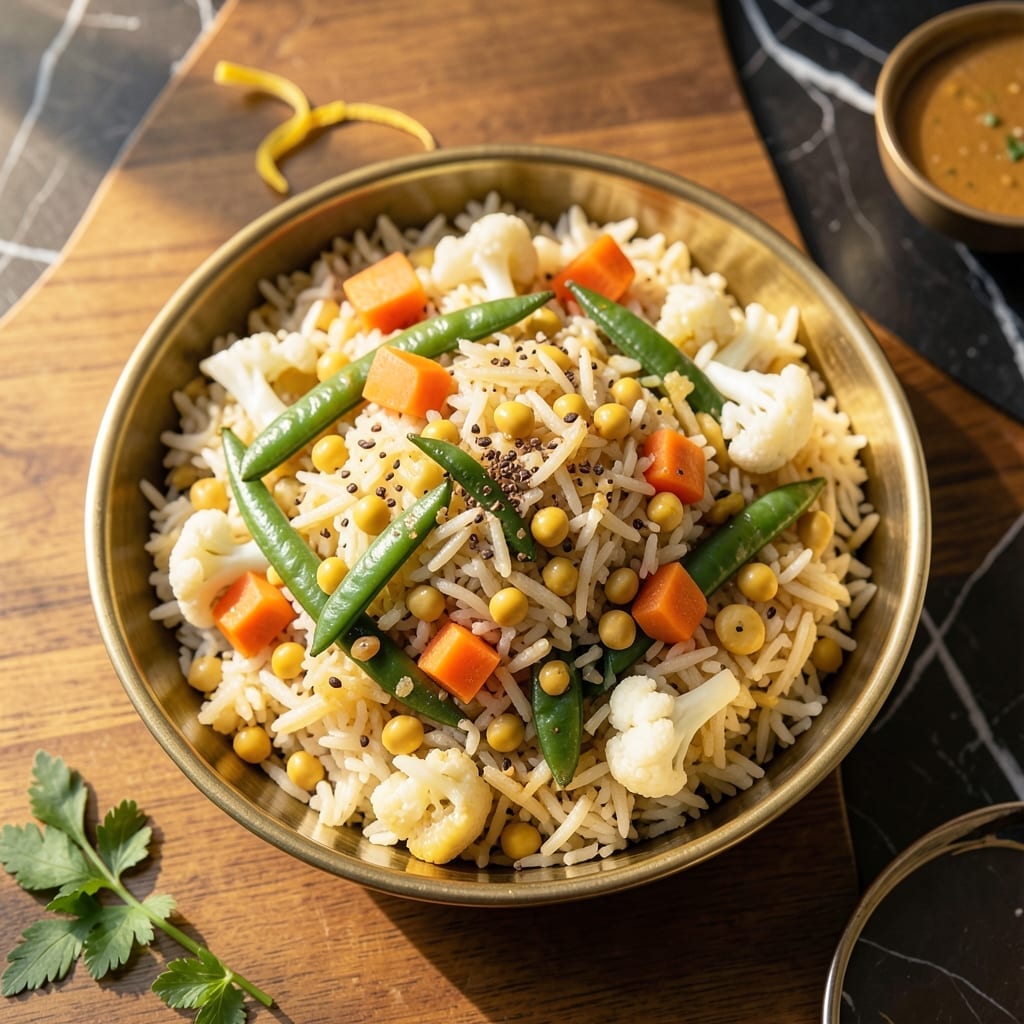
This South Indian specialty transforms everyday rice into a fragrant, flavorful feast using traditional spices and a simple one-pot method.
The dish combines basmati rice with lentils, vegetables, and a carefully balanced spice blend that fills your kitchen with an irresistible aroma. Each ingredient plays a distinct role in creating layers of taste and texture.
What emerges is a colorful, aromatic rice dish that’s hearty enough for a main course yet light enough for everyday meals. The spices toast to release their full potential, infusing every grain with warmth and depth.
Perfect for family dinners or special occasions, this creation brings authentic South Indian flavors to your table with minimal effort.
Ingredients for Kadambam Rice
Basmati rice, lentils, and fresh spices create this fragrant one-pot South Indian classic with vibrant flavor.
| Ingredient | Amount | Notes |
|---|---|---|
| Basmati Rice 🌾 | 1 ½ cups | Rinsed and drained well |
| Yellow Moong Dal 🥣 | ½ cup | Split and washed |
| Mixed Vegetables 🥕 | 2 cups | Diced carrots, peas, beans |
| Ghee 🧈 | 3 tbsp | Clarified butter preferred |
| Mustard Seeds 🌿 | 1 tsp | Black or brown variety |
| Cumin Seeds 🌿 | 1 tsp | Whole, not ground |
| Chana Dal 🥣 | 1 tbsp | Split chickpea lentils |
| Urad Dal 🥣 | 1 tbsp | Black gram lentils |
| Dried Red Chilies 🌶️ | 2 whole | Broken into pieces |
| Curry Leaves 🍃 | 10 pieces | Fresh preferred |
| Asafoetida 🌿 | ¼ tsp | Hing, for tempering |
| Turmeric Powder 🌶️ | ½ tsp | For golden color |
| Green Chilies 🌶️ | 2 whole | Slit lengthwise |
| Fresh Ginger 🌿 | 1 tbsp | Grated or finely chopped |
| Salt 🧂 | 1 tsp | Adjust to taste |
The ghee is non-negotiable here—Patel Brothers or Indian grocery stores have the best quality for authentic flavor. Basmati rice must be aged (look for brands like Daawat or India Gate), and rinse it until the water runs clear. Fresh curry leaves are ideal (find them at Asian markets), but dried work in a pinch. Asafoetida is the secret umami boost—don’t skip it.
No ghee? Coconut oil works, but the flavor changes slightly. Missing curry leaves? Bay leaves at half the amount add a similar depth. For the dals, yellow split peas can replace moong dal if needed. The vegetables are flexible—use whatever’s in season (cauliflower, potatoes, or even corn). Just keep the total volume around 2 cups.
This keeps well for 3-4 days in the fridge—the flavors deepen overnight. Freezes beautifully for up to 3 months. Reheat with a splash of water to bring back the moisture. Always store the rice and dal blend separately if prepping ahead.
Why You’ll Love This Recipe
- One Pot Wonder: I just dump everything in—rice, moong dal, veggies—and let it cook while I set the table.
- Ghee Magic: That first whiff of mustard seeds popping in ghee? I swear it makes the whole kitchen smell like a South Indian feast.
- Lunchbox Hero: My kids actually finish their lunches when I pack this. Between us, it reheats beautifully the next day.
- Budget Stretcher: A cup of dal and a handful of rice feeds four of us. Honestly, it’s my go-to when the fridge looks sad.
Step-by-Step Instructions for Kadambam Rice
Here’s how I make this South Indian classic with perfect texture and layered flavors.
Step 1: Prepare the Rice and Lentils
Rinse the 1.5 cups Basmati Rice thoroughly until the water runs clear, then drain well. In a separate bowl, wash the 0.5 cup Yellow Moong Dal and drain. I find that soaking both for 15 minutes improves texture, but it’s optional if you’re short on time.
Combine the rice and moong dal in a pot with 4.5 cups water and the 1 tsp Salt. The water should be just enough to cover the rice by about an inch. This ratio ensures the grains cook evenly without turning mushy.
Step 2: Temper the Whole Spices
Heat 2 tbsp Ghee in a heavy-bottomed pan over medium heat. Add the 1 tsp Mustard Seeds and let them pop for about 30 seconds until they sizzle and dance in the pan. This is your cue to proceed.
Immediately add the 1 tsp Cumin Seeds, 1 tbsp Chana Dal, and 1 tbsp Urad Dal. Stir constantly for 1-2 minutes until the dals turn a light golden brown. Then add the 2 whole Dried Red Chilies, 10 pieces Curry Leaves, and 0.25 tsp Asafoetida. The asafoetida will bloom in seconds, releasing its pungent aroma.
Step 3: Cook the Aromatics and Vegetables
Toss in the 1 tbsp Fresh Ginger and 2 whole Green Chilies, stirring for 30 seconds until the ginger becomes fragrant. Then add the 2 cups Mixed Vegetables and 0.5 tsp Turmeric Powder. Stir to coat everything in the spiced ghee.
Cook the vegetables for 5-6 minutes on medium-low heat until they soften slightly but retain their shape and vibrant color. The turmeric will give the mixture a beautiful golden hue. Add the remaining 1 tbsp Ghee at this stage for extra richness.
Step 4: Combine and Finish Cooking
By now, your rice and dal mixture should be about 70% cooked. Drain any excess water and add the rice to the vegetable-spice mixture. Gently fold everything together, ensuring the grains are well-coated and the spices are evenly distributed.
Cover the pan and cook on low heat for 8-10 minutes. You’ll know it’s done when the rice is tender, the grains are separate, and the lentils are soft but not mushy. Turn off the heat and let it sit covered for 5 minutes to allow the flavors to meld completely.
Pro Tips For Making Kadambam Rice
- Toast the Moong Dal: Dry-roast the yellow moong dal for 2-3 minutes on medium heat until fragrant—this removes raw taste and deepens the nutty flavor that makes kadambam rice special.
- Soak the Basmati: Rinse and soak the basmati rice for exactly 20 minutes before cooking; any longer and it turns mushy, any shorter and it stays undercooked. I learned this the hard way after ending up with a paste-like texture.
- Temper the Mustard Seeds: Heat the ghee first, then add mustard seeds only when it’s hot enough to make them pop within 10 seconds—if they don’t, your tempering will taste flat and lifeless.
- Use Cold Water: After toasting the dal and tempering the spices, add cold water to the rice and dal mixture. This prevents the rice from turning sticky and keeps each grain separate, just like it should be in a good kadambam rice.
Essential Equipment for kadambam rice
Heavy-Bottomed Pan
A heavy-bottomed stainless steel or cast iron pan is essential for even heat distribution when tempering spices. I use my 5-quart Lodge cast iron for this—it prevents hot spots that can burn the mustard seeds or dals. Avoid thin aluminum pans. 🔥
Tempering Equipment
Invest in a long-handled wooden spatula for stirring the tempering spices. The long handle protects your hands from the hot ghee splatters. A splatter screen is also helpful if you’re new to tempering whole spices.
Rice Cooking Pot
Use a 3-4 quart pot with a tight-fitting lid for cooking the rice and dal mixture. I prefer my Cuisinart stainless steel pot—it conducts heat evenly and has a heavy base. The lid should seal well to trap steam.
Spice Grinder
While whole spices are used here, a dedicated coffee/spice grinder comes in handy for freshly grinding cumin or other spices if you want to experiment. I use a Cuisinart SG-10 for this purpose.
Measuring Tools
Accurate measurements are key for perfect texture. I use OXO Good Grips measuring cups and spoons—they’re durable and easy to read. A kitchen scale is helpful for the rice and dal if you want to be precise.
Serving Dish
Serve your kadambam rice in a wide, shallow bowl to showcase the colorful mix. I love my ceramic serving dish from World Market—it retains heat well. A rice paddle helps fluff the grains without breaking them. ✨
Nutrition Facts
Frequently Asked Questions
Can I use regular rice instead of basmati?
Basmati is ideal for its fragrance, but you can use long-grain white rice. Adjust water to 4 cups and expect slightly less aromatic results. The texture will differ but still taste great.
How do I prevent the rice from turning mushy?
Rinse the rice thoroughly and use the exact 4.5 cups water for 1.5 cups rice. Cook on low heat only after combining with vegetables. This maintains grain separation.
What if I don’t have all the dals?
You can use just yellow moong dal or substitute with toor dal. The flavor will vary slightly but remain delicious. Skip chana/urad dal if needed—the dish will still work.
Can I make this dish without ghee?
Yes, substitute with coconut oil or neutral oil. Ghee adds authentic flavor, but the dish will still taste good. Use the same 3 tbsp measurement for any substitute.

- Curd Rice Recipe: South Indian Comfort With Cooling Yogurt - September 25, 2026
- Rice Mix Recipe: Fluffy Grains With Customizable Flavor Boost - September 25, 2026
- Soupy Rice Recipe: Broth-Soaked Grains With Rustic Depth - September 25, 2026