
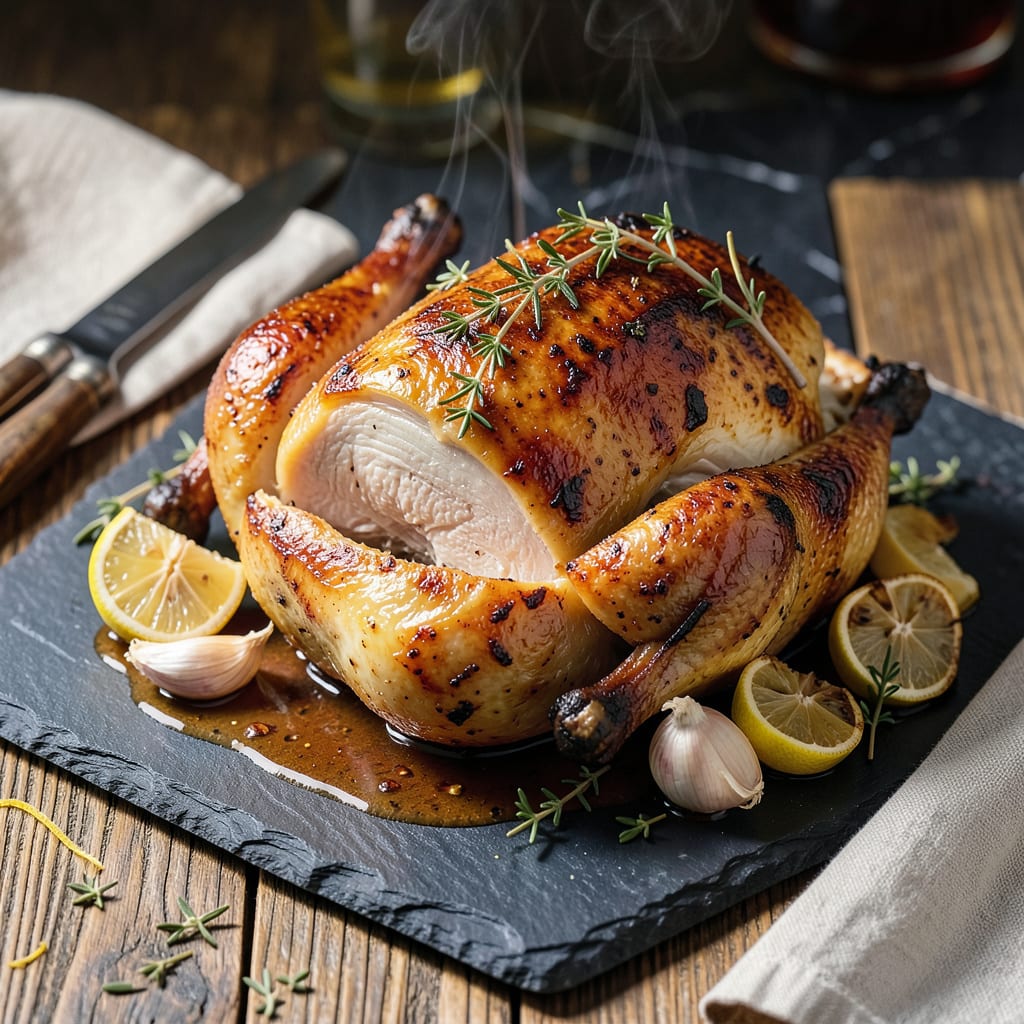
Spatchcock chicken is fully cooked and safe to eat when it reaches an internal temperature of 165°F (74°C) in the thickest part of the breast and thigh. Use an instant-read thermometer for accuracy, as even cooking is key with this method.
This temperature benchmark isn’t arbitrary—it’s the USDA’s gold standard for eliminating harmful bacteria like salmonella while keeping the meat juicy. 🔥 What makes spatchcocking different is how the flattened shape exposes more surface area, requiring vigilant monitoring to prevent dry edges while waiting for the center to reach safety. I’ve found that dark meat often hits temp before white meat in this method, so rotating the pan halfway through can help balance the heat distribution.
Pro chefs swear by this technique because it cuts cooking time nearly in half compared to whole roasting. ✨ The key is checking multiple spots—the thickest part of the breast near the wing joint, the inner thigh near the bone, and the center of the leg quarter—since the flattened bird cooks more unevenly than you might expect.
💡 In This Article
- Why 165°F Is the USDA-Recommended Spatchcock Temperature
- Pro Tips for Hitting the Perfect Spatchcock Chicken Temp
Why 165°F Is the USDA-Recommended Spatchcock Temperature
The 165°F (74°C) benchmark isn’t just a random number—it’s the temperature where harmful bacteria like salmonella are instantly destroyed. At this point, the proteins in chicken denature completely, breaking down collagen and ensuring both safety and tenderness.
What’s fascinating is that spatchcocking exposes more surface area to heat, which means the outer edges cook faster while the center needs careful monitoring to reach this critical threshold. 🔥
Unlike whole-roasted chicken where heat penetrates gradually from the outside in, spatchcocked chicken cooks more evenly but requires precision. The flattened shape means dark meat (thighs, legs) often hits 165°F before white meat (breasts), which can dry out if overcooked.
I’ve found that checking multiple spots—the thickest part of the breast, inner thigh near the bone, and leg center—gives the most accurate reading since heat distribution varies across the bird.
Here’s what’s happening at the molecular level: At 140°F (60°C), collagen begins converting to gelatin, but it’s not until 165°F that all pathogenic bacteria are neutralized. The USDA chose this temperature because it provides a 7-log reduction in salmonella—meaning it kills 99.99999% of bacteria.
For spatchcocked chicken, this is especially crucial because the exposed surfaces can harbor more bacteria than a whole bird’s protected cavity.
Comparatively, whole-roasted chicken can sometimes be safely cooked to 155°F (68°C) if held at that temperature for 55 seconds (pasteurization method), but spatchcocking doesn’t allow for this time-based approach. The increased surface area means faster cooking, so you can’t rely on residual heat to finish the cooking process.
That’s why instant-read thermometers are non-negotiable—guessing with spatchcock chicken is a recipe for either undercooked or dried-out meat. ⚡
Pro tip: If you’re smoking or slow-cooking your spatchcock chicken, you can safely pull it at 155°F (68°C) and let it rest to reach 165°F through carryover cooking. But for high-heat methods like grilling or roasting at 425°F (220°C), you’ll want to hit 165°F on the thermometer before resting.
The difference comes down to time—low-and-slow gives bacteria more exposure to heat, while high heat requires the full 165°F benchmark for instant safety.
What most home cooks don’t realize is that chicken continues cooking after removal from heat. A properly spatchcocked bird will rise another 5-10°F during resting, so I recommend pulling it at 160°F (71°C) for white meat and 165°F (74°C) for dark meat.
This accounts for carryover while preventing overcooking—especially important with spatchcock’s thin profile, where just 2-3 minutes too long can turn juicy breast meat into sawdust. 💫
The science behind this is called “thermal inertia”—the bird’s mass retains heat and continues transferring it inward even after leaving the oven. Spatchcocking accelerates this process because the flattened shape has less thermal mass than a whole chicken.
That’s why resting for 10-15 minutes under foil is critical: it allows juices to redistribute while the temperature equalizes, giving you perfectly cooked meat from edge to center.

- Jollof Rice Sauce Recipe: West African Tomato and Spice Infusion - September 25, 2026
- Japanese Rice Soup Recipe: Umami-Rich Comfort in a Bowl - September 25, 2026
- Homemade Cream Of Rice Recipe: Silk-Smooth Breakfast in Minutes - September 25, 2026