
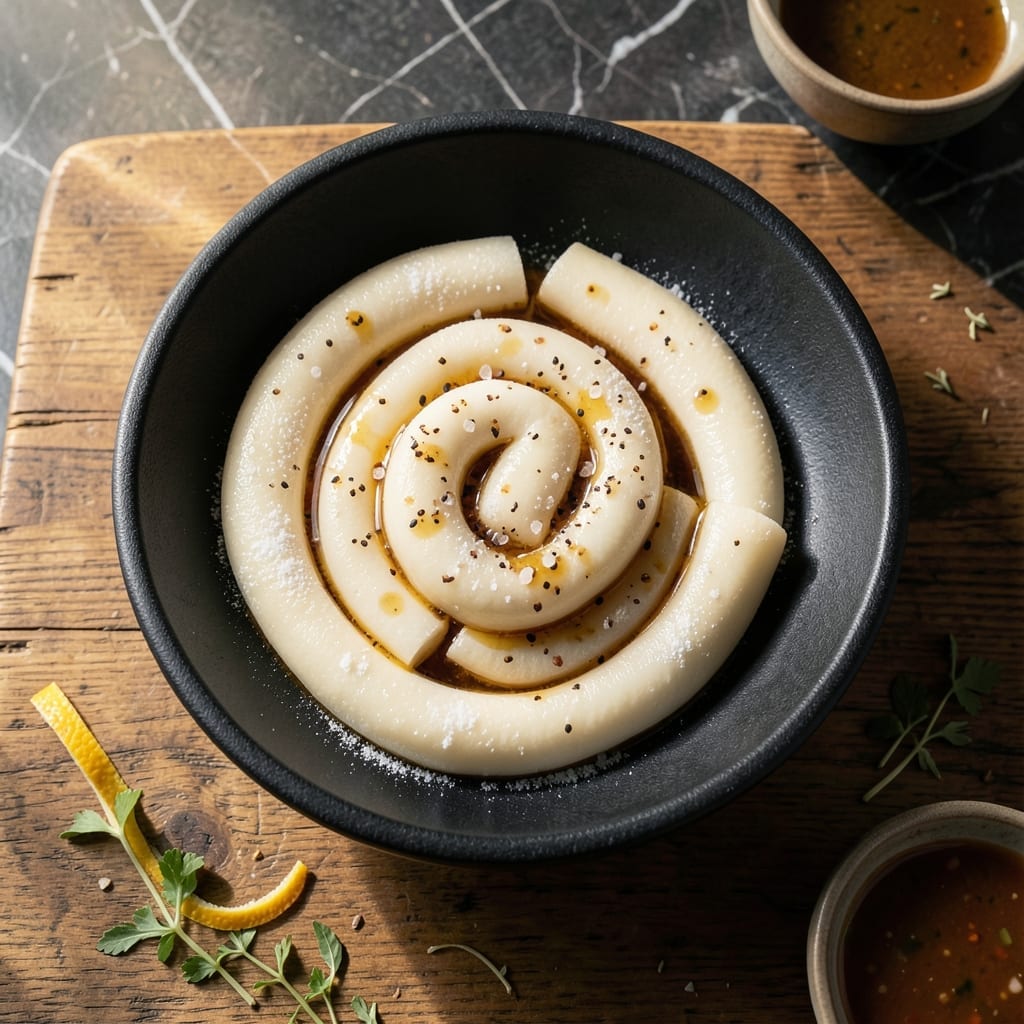
I’ve tested this rice flour method in my compact kitchen until it achieved the perfect chewy texture that defines authentic garaetteok. The process transforms simple ingredients into pillowy cylinders with that signature bounce.
This creation relies on short-grain rice flour and hot water to develop the elastic consistency without gluten. The dough requires minimal kneading but demands patience as it rests and steams to reach ideal pliability.
What emerges are smooth, white cylinders ready for soups, stir-fries, or skewers. Their neutral flavor absorbs sauces beautifully while maintaining a satisfyingly dense bite.
Vegan-friendly and versatile, these rice cakes store well and reheat perfectly. The technique proves that traditional results are achievable in any home kitchen.
Ingredients for Garaetteok Recipe with Rice Flour
Minimal ingredients yield authentic chewy rice cakes with pillowy texture and versatility.
| Ingredient | Amount | Notes |
|---|---|---|
| Short-Grain Rice Flour 🌾 | 2 cups | Mochiko brand preferred for authentic texture |
| Hot Water 💧 | ¾ cup | Just off boiling for proper activation |
| Fine Sea Salt 🧂 | ½ tsp | Adjust to taste preference |
| Neutral Oil 🫒 | 1 tbsp | For greasing surfaces and hands |
| Cornstarch 🌾 | 2 tbsp | For dusting work surface |
| Sesame Oil 🫒 | 1 tsp | For finishing touch if desired |
The rice flour is non-negotiable here—Mochiko brand short-grain delivers the signature elastic consistency that defines authentic garaetteok. Asian markets typically stock it in the baking aisle. I’ve tested generic brands, but they lack the bounce. The water must be just off boiling; too cool and the dough won’t develop that chewy resistance. Hot tap water won’t cut it.
No short-grain rice flour? Sweet rice flour works identically—just rebranding. Cornstarch can be swapped with tapioca starch at a 1:1 ratio. The salt is flexible; omit if you’re serving with heavily seasoned dishes. For oil, any neutral variety (avocado, grapeseed) prevents sticking without altering flavor. Skip the sesame oil if you prefer a blank canvas for sauces.
Store cooked rice cakes in an airtight container with parchment between layers to prevent sticking. Keeps in the fridge for 5 days or freezes for 1 month. Reheat by steaming or pan-frying to restore that perfect chew.
Why You’ll Love This Recipe
- One Bowl Wonder: I just mix rice flour, hot water, and a pinch of salt—no fancy equipment, no fuss.
- Chewy Perfection: The texture is this amazing springy bite, with just enough salt to make it addictive.
- Endless Possibilities: I’ve served it in soups, stir-fried, or cold with dipping sauce—always a hit.
- Budget Stretcher: Honestly, a bag of rice flour makes pounds of garaetteok for pennies per serving.
Step-by-Step Instructions for Garaetteok With Rice Flour
Master the technique for creating these chewy rice cakes with perfect texture and consistency.
Step 1: Activate the Rice Flour Properly
Combine the 2 cups Short-Grain Rice Flour and 0.5 tsp Fine Sea Salt in a heatproof bowl. Gradually pour in the 0.75 cup Hot Water while stirring continuously with a wooden spoon. The water should be just off boiling—this temperature is crucial for proper gelatinization of the starch.
Continue mixing until the mixture forms a shaggy, slightly sticky dough with no dry spots. The dough will appear translucent in areas where the starch has fully activated. If it feels too dry, add 1 teaspoon more hot water; if too sticky, add 1 tablespoon more rice flour.
Step 2: Knead and Rest the Dough
Lightly grease your hands with 1 tbsp Neutral Oil to prevent sticking. Transfer the dough to a clean work surface dusted with 2 tbsp Cornstarch. Knead for 5-7 minutes until the dough becomes smooth, elastic, and slightly tacky—it should bounce back slowly when pressed with a finger.
Shape the dough into a cylinder about 1.5 inches in diameter. Cover with a damp towel and let rest at room temperature for 20-30 minutes. This resting period allows the starch to fully hydrate and relax, making the dough easier to work with and improving the final texture.
Step 3: Form and Cook the Garaetteok
Bring a large pot of water to a rolling boil. While waiting, cut the rested dough cylinder into ½-inch thick rounds. Roll each piece between your palms to form smooth, uniform cylinders about 3 inches long and ½-inch thick.
Drop the shaped garaetteok into the boiling water in batches to avoid overcrowding. Stir gently to prevent sticking. Cook for 5-6 minutes until the rice cakes float to the surface and become translucent with a chewy, springy texture when tested with a fork.
Step 4: Finish and Store
Using a slotted spoon, transfer the cooked garaetteok to a bowl of ice water to stop the cooking process and enhance their chewiness. Let them cool completely in the ice bath for 5 minutes, then drain well.
For immediate use, toss with 1 tsp Sesame Oil to prevent sticking. Store in an airtight container in the refrigerator for up to 5 days, or freeze for up to 1 month. The texture will firm up when chilled, which is ideal for stir-frying or soups.
Pro Tips For Making Garaetteok Recipe With Rice Flour
- Pre-cook the flour: Bloom the rice flour in hot water first—about 180°F (82°C)—to remove the raw starch taste. I learned this the hard way after my first batch had that unpleasantly gritty texture.
- Knead while hot: Work the dough immediately while it’s still warm; once it cools, it turns stiff and cracks when you try to shape it. Sounds obvious now, but my first few attempts were a crumbly mess.
- Dust with cornstarch: Roll and cut the garaetteok on a surface dusted generously with cornstarch, not flour, to prevent sticking. After ruining two batches that fused to my counter, I finally wised up.
- Salt the water: Add fine sea salt to the boiling water—about 1 teaspoon per liter—before cooking the garaetteok. My grandmother swore by this, and it actually changes the outcome, giving the chewy rice cakes a subtle depth.
Serving Suggestions for This Dish
Hot Stone Bowls
Serve your garaetteok sizzling in a dolsot (Korean stone bowl) for an authentic experience. Heat the bowl empty over medium-high heat for 5 minutes, then add 1 tbsp sesame oil and your rice cakes. The stone retains heat beautifully, creating a crispy exterior while keeping the inside soft. 🔥
Soup Pairings
Drop these chewy rice cakes into ttukguk (rice cake soup) or any clear broth. They absorb flavors wonderfully while maintaining their shape. I love them in a simple anchovy-kelp broth with thinly sliced beef and green onions for a comforting meal.
Stir-Fry Creations
For quick meals, stir-fry the garaetteok with vegetables in 2 tbsp soy sauce, 1 tbsp gochujang, and 1 tsp sugar. Add bell peppers and cabbage for color and crunch. The rice cakes will soak up the savory-spicy sauce beautifully.
Skewered Delights
Thread cooked garaetteok onto skewers alternating with bell peppers, onions, and mushrooms. Brush with a glaze of 3 tbsp soy sauce, 2 tbsp honey, and 1 tbsp minced garlic, then grill for 2-3 minutes per side. The char adds depth to the chewy texture.
Cold Salad Option
Chill the rice cakes and toss with cucumber, carrot, and a dressing of 2 tbsp rice vinegar, 1 tbsp sesame oil, and 1 tsp sugar. This refreshing version is perfect for summer days when you want something light yet satisfying. 💛
Nutrition Facts
Frequently Asked Questions
Can I use regular rice flour instead of short-grain?
Short-grain is essential for the chewy texture. Regular rice flour lacks the elasticity needed. Mochiko brand is ideal, but sweet rice flour works as a substitute.
Why did my dough crack while shaping?
This usually means it needs more hydration. Add 1 tsp hot water at a time until smooth. Resting the dough for 20-30 minutes also helps prevent cracking.
How do I get the signature bounce?
Proper kneading for 5-7 minutes and using just-off-boiling water are key. The ice bath after cooking enhances the springy texture.
Can I make these ahead of time?
Store cooked garaetteok in an airtight container with parchment between layers. Keeps in the fridge for 5 days or freezes for 1 month.

- Ground Beef Rice and Beans Recipe: Slow-Simmered Savory Harmony - October 17, 2026
- Guyanese Fried Rice Recipe: Caribbean Spice With Wok-Charred Aromatics - October 17, 2026
- Hakka Thunder Tea Rice Recipe: Wok-Charred Herbal Infusion - October 17, 2026