
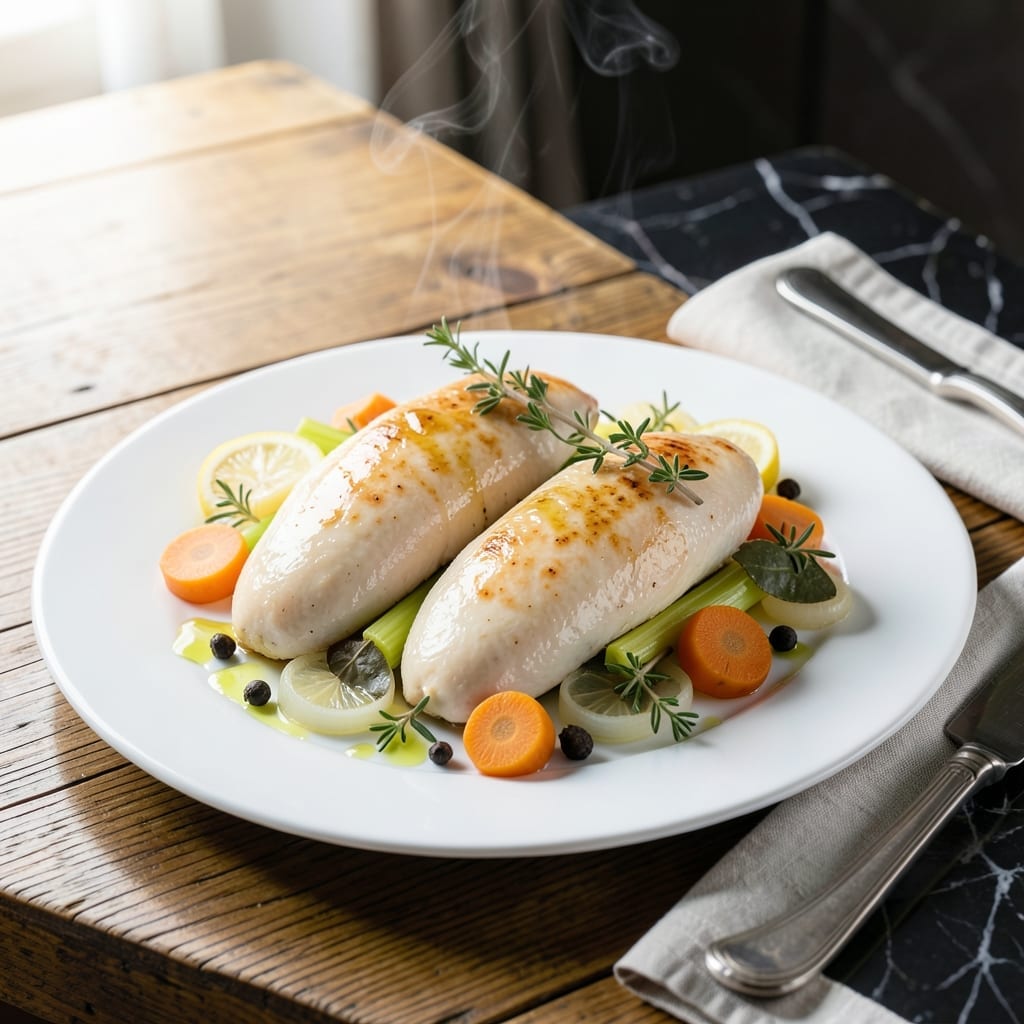
This poaching method guarantees tender chicken breasts every time with almost no hands-on work. The gentle simmering process keeps the meat juicy while infusing subtle flavor from the cooking liquid.
I rely on this technique for meal prep because it produces perfectly cooked chicken that stays moist for days. The key is maintaining a steady temperature just below boiling to prevent toughness.
You’ll end up with versatile cooked chicken ready for salads, sandwiches, or casseroles. The meat comes out uniformly cooked with a delicate texture that’s impossible to achieve with dry heat methods.
With just water, aromatics, and 15 minutes of cooking time, this becomes your go-to method for reliable results.
Ingredients for Poaching Chicken Breasts
Simple aromatics and chicken create a foolproof poaching liquid for tender results.
| Ingredient | Amount | Notes |
|---|---|---|
| Boneless, Skinless Chicken Breasts 🍗 | 1 ½ lb | Uniform thickness for even cooking |
| Water 💧 | 6 cups | Or low-sodium chicken broth |
| Kosher Salt 🧂 | 1 tbsp | Diamond Crystal preferred |
| Black Peppercorns 🌶️ | 1 tsp | Whole, lightly crushed |
| Bay Leaves 🍃 | 2 whole | Dried, for aroma |
| Fresh Thyme Sprigs 🌿 | 3 pieces | Or 1 tsp dried thyme |
| Garlic Cloves 🧄 | 4 cloves | Smashed, peeled |
| Yellow Onion 🧅 | ½ whole | Quartered, skin on |
| Lemon 🍋 | ½ whole | Sliced, for brightness |
| Carrot 🥕 | 1 whole | Roughly chopped |
| Celery Stalks 🥬 | 2 pieces | Roughly chopped |
| Fresh Parsley 🌿 | ¼ cup | Chopped, for garnish |
The chicken quality matters here. Boneless, skinless breasts from a reputable source like Whole Foods or Costco ensure consistent texture. Look for uniform thickness or pound thicker parts to even them out. The water can be swapped for low-sodium broth for extra flavor depth. Fresh aromatics—thyme, bay leaves, garlic—make a noticeable difference over dried.
No thyme? Dried at one-third the amount works, but fresh is ideal. Out of bay leaves? A pinch of ground bay leaf can substitute. The vegetables are flexible—leeks or fennel add nice variation. For acidity, vinegar can stand in for lemon if needed. Salt quantity assumes Diamond Crystal; halve it if using Morton.
Cooked chicken keeps 4-5 days refrigerated in its liquid or tightly wrapped. Freeze for 3 months (slice first for easy portioning). The poaching liquid doubles as a light broth—strain and save for soups or cooking grains.
Why You’ll Love This Recipe
- Set and Forget: I just drop the chicken in simmering water with salt and peppercorns, then walk away—no babysitting required.
- Pure Chicken Flavor: The bay leaves and peppercorns infuse the breasts with a subtle depth that’s way better than plain boiled chicken.
- Meal Prep MVP: I poach a batch on Sunday and use it in salads, tacos, or sandwiches all week long.
- Budget Stretcher: A pound of chicken breasts turns into multiple meals, and the broth? I save it for soups or cooking rice.
Step-by-Step Instructions for Poaching Chicken Breasts
This gentle cooking method guarantees moist, tender results with precise temperature control.
Step 1: Prepare the Poaching Liquid
In a large, deep skillet or saucepan, combine the 6 cups Water with 1 tbsp Kosher Salt, 1 tsp Black Peppercorns, 2 whole Bay Leaves, and 3 pieces Fresh Thyme Sprigs. Add the 4 cloves Garlic Cloves, 0.5 whole Yellow Onion, 0.5 whole Lemon, 1 whole Carrot, and 2 pieces Celery Stalks.
Bring the mixture to a full boil over high heat, then reduce to medium-low to maintain a gentle simmer. The liquid should shimmer with small bubbles, never a rolling boil. This ensures even heat distribution without shocking the chicken.
Step 2: Add the Chicken and Maintain Temperature
Carefully submerge the 1.5 lb Boneless, Skinless Chicken Breasts in the simmering liquid. I use tongs to lower them in slowly to prevent splashing. The breasts should be fully covered—add a splash of water if needed.
Adjust the heat to maintain a steady 160-180°F range. You’ll see the chicken turn opaque around the edges within 5-7 minutes. Resist the urge to poke or prod; let the gentle heat work its magic.
Step 3: Poach to Perfect Doneness
Continue poaching for 12-15 minutes total, depending on thickness. The chicken is done when an instant-read thermometer registers 165°F in the thickest part. Alternatively, pierce the center with a knife tip—if the juices run clear, it’s ready.
Real talk: Overcooking is the enemy here. At the first sign of doneness, remove the pan from heat immediately. The chicken will carry over cook to 170°F as it rests in the hot liquid.
Step 4: Rest and Finish
Transfer the chicken to a cutting board and let it rest for 5 minutes. This allows the muscle fibers to relax and retain moisture. Meanwhile, strain the poaching liquid if you plan to use it for sauce or soup—it’s packed with flavor.
Once cooled slightly, slice or shred as needed. For serving, garnish with 0.25 cup Fresh Parsley for a bright, fresh finish. The result should be uniformly white throughout with a velvety texture that holds up in salads, sandwiches, or standalone dishes.
Pro Tips For Making Poaching Chicken Breasts
- Start in Cold Water: Always place the chicken in cold water with the salt and aromatics before turning on the heat—I learned this the hard way after ending up with tough, unevenly cooked breasts.
- Keep It Gentle: Maintain the water at a bare simmer, around 160-180°F; any higher and the chicken turns rubbery, no matter how carefully you time it.
- Pound the Thickness: If your breasts are uneven, give them a quick pound to an even 1-inch thickness—guarantees they cook through without the thin ends drying out.
- Use the Poaching Liquid: Don’t toss that flavorful broth—strain and use it for soups, sauces, or cooking grains; it’s packed with chicken essence and the bay leaf’s earthy depth.
Troubleshooting Perfect Results
Cloudy Liquid Issue
If your poaching liquid looks murky, it’s likely from impurities in the chicken. Skim the surface with a fine-mesh strainer during the first 5 minutes of simmering. I keep a small ladle handy for this exact purpose. 💡
Dry Chicken Problem
Overcooking is the main culprit for dry results. Pull the chicken at 160°F internal temperature—it will rise to 165°F while resting. Use a reliable thermometer like ThermoWorks for accuracy.
Uneven Cooking
Thicker parts of the breasts cook slower. Pound them to uniform 1-inch thickness before poaching. Alternatively, cut larger breasts in half horizontally to ensure even doneness throughout.
Bland Flavor
Under-seasoned poaching liquid leads to bland chicken. Taste the liquid before adding chicken—it should taste pleasantly seasoned. I add an extra ½ tsp salt if needed. The aromatics should be fragrant and noticeable. 🌿
Rubbery Texture
Boiling instead of simmering causes rubbery chicken. Maintain a gentle simmer with tiny bubbles, not a rolling boil. If your burner runs hot, use a diffuser or partially cover the pan to regulate heat.
Chicken Sticks
Prevent sticking by ensuring the chicken is fully submerged. If pieces float, place a heatproof plate on top to keep them under the liquid. Nonstick pans or enameled cast iron also help prevent this issue.
Nutrition Facts
Frequently Asked Questions
What liquid works best for poaching?
Water works perfectly, but low-sodium chicken broth adds more flavor. For extra depth, try a mix of broth and white wine. Always ensure the chicken stays fully submerged throughout cooking.
How can I tell when it’s done?
Use an instant-read thermometer to check for 165°F in the thickest part. Alternatively, pierce the center—if juices run clear, it’s ready. Overcooking leads to dry meat, so remove it immediately at this stage.
Can I reuse the poaching liquid?
Strain and store it in the fridge for up to 3 days. It makes a great base for soups, rice, or sauces. The liquid absorbs lots of flavor from the chicken and aromatics.
Why did my chicken turn out rubbery?
This usually happens if the liquid was boiling instead of simmering. Keep the heat at medium-low with tiny bubbles, never a rolling boil. A diffuser can help regulate temperature if needed.

- Jollof Rice Sauce Recipe: West African Tomato and Spice Infusion - September 25, 2026
- Japanese Rice Soup Recipe: Umami-Rich Comfort in a Bowl - September 25, 2026
- Homemade Cream Of Rice Recipe: Silk-Smooth Breakfast in Minutes - September 25, 2026